Posts Tagged ‘sightseeing’

Saturday
January
26th
2008
2:47 pm

The Butter Museum at Máslovice

Last month, one of my students told me, in response to my usual "So, what did you do this weekend?", that she and her boyfriend had visited the Butter Museum at Máslovice.

"Wait: did you say butter?"

"Yes, the Butter Museum."

"Butter? The yellow stuff they make with milk and you spread it on your bread? Butter?"

"Yes, the Butter Museum. They have a Betlem (Nativity scene) made out of butter."

"So wait, now where is this? Máslovice? Where’s that?"

"I’ll bring you a map."

And the next class, she did indeed bring me

  • a map showing where to find the correct bus stop at the Kobylisy metro station;
  • a map of Máslovice, showing where the museum is in relation to the bus stop;
  • a bus schedule; and
  • notes about when the museum is open (Saturday and Sunday, from 10 to 12 and from 1 to 4) and how long the Betlem would be there (from the beginning of December through the end of January).

Máslovice is north of Prague, and there’s a certain logic to a Butter Museum being housed there, as the Czech word for butter is máslo. The bus ride from the Kobylisy metro station takes about 30 minutes. The countryside surrounding Prague becomes rural amazingly quickly, and the map of Máslovice was really not necessary, as there’s hardly anything there and the museum, small as it is, was hard to miss.

The "curator" is a very nice young man named David, who seemed delighted to have a native English speaker to practice his (very good) English on. He willingly showed me through the museum, explaining the exhibits, leaving my side only to collect the admission fee from other visitors and then returning to continue our conversation. There is in fact no butter connection to Máslovice: the town was named after a person named Máslovics. I asked about the Betlem: it was carved by a 24-year old actress living in Prague, but this was to be its last weekend. It was beginning to stink, David candidly observed. Only the third of the three rooms of the museum is devoted to butter, but it is full of butter making implements and paraphernalia, including butter molds, a collection of butter wrappers from around the world, and more kinds of churns than I had ever realized existed. I was particularly taken with one in the form of a child’s rocking horse. The container for the milk forms the body of the horse, so the child’s rocking can churn the butter. I thought that was particularly ingenious.

The second of the three rooms of the museum is actually dedicated to chocolate. It turns out that the person who is listed in the Guinness Book of World Records as having the largest number of chocolate wrappers is a Czech (though not an inhabitant of Máslovice), and it’s a rotating portion of his collection that is on display.

The first of the three rooms is just the gift shop/reception area. If you’re in the Prague area looking for gifts depicting cows, this is where you want to come.

The weekend of April 12-13, there’s to be a Butter Festival at which visitors will be able to participate in making their own butter. I’m thinking that it might be fun to go back for that.
Monday
August
6th
2007
1:45 am

Getting Outside of Prague, Part 2

The other trip I’ve taken outside of Prague since my arrival was to Kutna Hora, a UNESCO-protected Heritage site.

Kutna Hora mainly came to fame in the 13th century because it was close to the site of some very prolific silver mines; it remained one of the richest cities in Bohemia until the mines finally petered out in the 18th century.

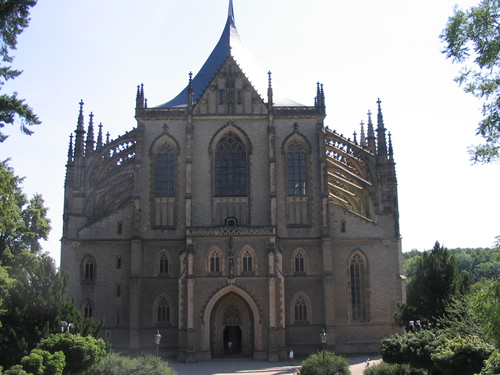
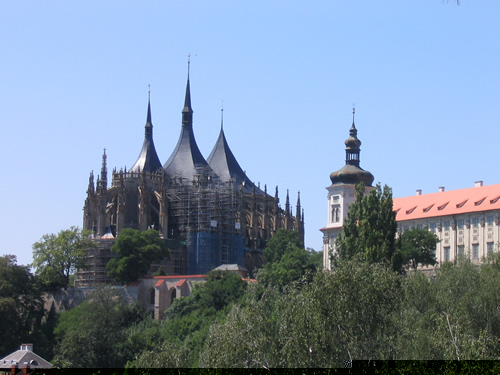
Sites in Kutna Hora include the Cathedral of St. Barbara (the patron saint of miners):

Another view of St. Barbara’s, including a charming view of the scaffolding:

Instead of the usual crucifix, the altarpiece is a painted bas-relief of the Last Supper, which is something I’ve never seen before, but which makes perfect sense.

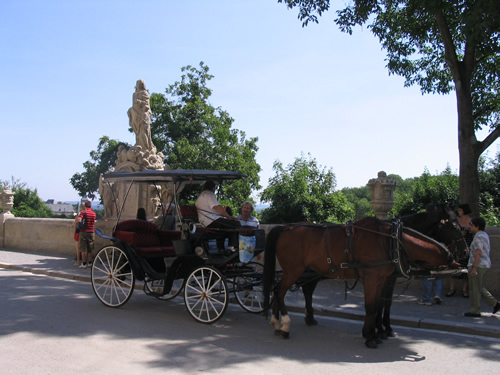
Horse-drawn carriages are a popular tourist fixture in Kutna Hora (in Prague as well):

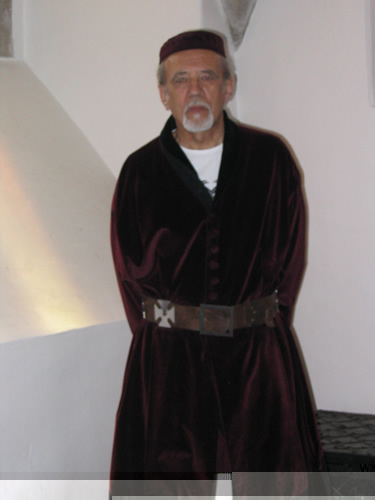
The proximity of Kutna Hora to the silver mines led to the establishment of a Royal Mint. We toured the site of the mint, where coinmaking was demonstrated by a resident coinmaker:

I had always thought that coins were molded, but instead (at Kutna Hora, at least) they were stamped.

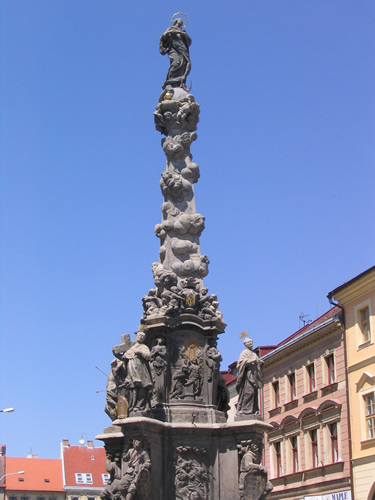
We passed by a plague memorial:

All in all, while Kutna Hora is a very pretty town, it didn’t really seem to be worth the trouble of the trip, and I’m not quite clear on why UNESCO has chosen to add it to its list of Heritage sites. Of course, I visited on a Sunday, when everything was shut down. I might have derived a more positive impression had it been livelier.

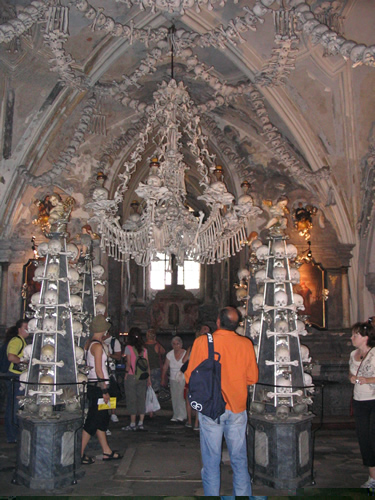
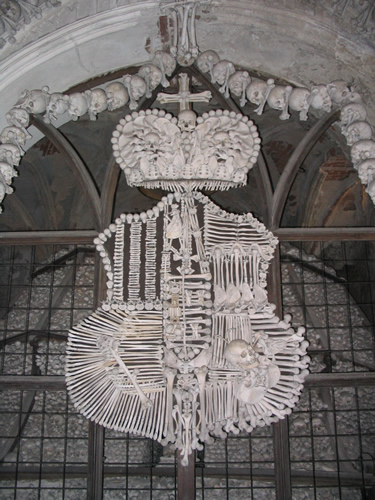
The tour included a trip to the Sedlec Ossuary, which was indeed worth the visit. The ossuary is home to something like 40,000 (!) human skeletons, which form some of the "decorations" for the chapel. This chandelier, for example:

Or this coat of arms, for the Schwarzenberg family:

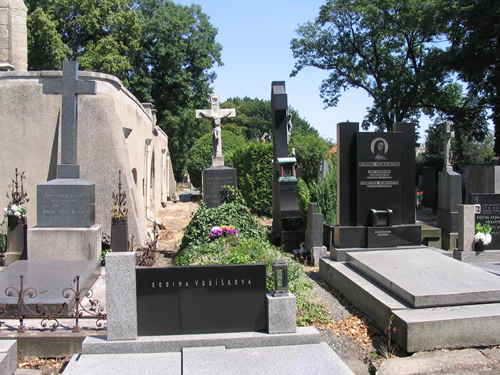
There’s also an unremarkable graveyard outside the chapel:

Monday
August
6th
2007
12:16 am

Prague Slideshow

Ya know, sometimes one of the reasons that I hold off on posting is because I have all these photos piled up, and so I wait ’til I get them formatted, then I have to think about how to weave them into a coherent narrative, and it’s just all so daunting that I put it off and put it off and put it off…

So, I’m just going to put up this little slideshow, mostly from a walking tour I took of Prague, and then I can just get on with posting about life here without having these photos hanging over my head!

Tuesday
July
24th
2007
2:46 pm

That Last Week in Paris…

I had that one last week after the end of classes and before coming to Prague. So I took advantage of the opportunity to play tourist and to take a few more pictures to remind myself of my sojourn in Paris.

Sunday in Montmartre

I spent one day wandering up and down staircases in Montmartre:

I also liked this view of Sacré Cœur from the little park around in back of the Basilica:

And I had dinner one last time in Montmartre:

Tuesday on the Seine

I finally took one of the Bateaux Mouches trips. I can’t really say that I was all that impressed, and I probably wouldn’t do it again. But it does provide a different view of Paris:


There are a couple of reduced scale versions of the Statue of Liberty in Paris: one is in the Luxembourg Gardens, and another is on an island in the Seine:

After my little boat trip, I just wandered around a bit, and came across this memorial:

The caption reads, "In homage to Komitas, composer and musicologist, and to the 1,500,000 victims of the Armenian genocide of 1915, perpetrated by the Ottoman Empire".

Marais and the Bastille

Another day, I wandered around the Marais and visited the Place de la Bastille:

I encountered this statue of Louis XIII in a plaza near the Marais:

I also visited the Memorial of the Shoah, which I had been unable to find the first time I had looked. It’s not very big, and it’s easy to get disoriented in the windy little streets of the Marais. The memorial is very moving:

The inscription on the outside reads, "Before the Unknown Jewish Martyr, incline your head in piety and respect for all the martyrs; incline your thoughts to accompany them along their path of sorrow. They will lead you to the highest pinnacle of justice and truth."

The exterior also contains the Wall of Names: the names and dates of birth of the 76,000 Jews, including 11,000 children, deported from France as part of the Nazi plan to annihilate the Jews of Europe with the collaboration of the Vichy government.

Inside, there’s the crypt:

A Star of David fashioned out of black marble, marks the tomb of the six million Jews, dead without a grave. It contains the ashes of martyrs taken from the death camps and from the ruins of the Warsaw Ghetto. The ashes were buried on February 24,1957 in earth from Israel, in keeping with tradition, by Chief Rabbi Jacob Kaplan. An eternal light burns at the center of the marble star. There’s quotation from the Bible in Hebrew on the far wall: "Look and see if there is any sorrow like my sorrow. Young and old, our sons and daughters were cut down by the sword".

The permanent exhibition details the history of the "Final Solution" in France, and includes biographies of a handful of Jews resident in France at the time the Occupation began. It was not a cheery experience, but it was an important site to see.

Carousels of Paris

And there are carousels all over the place in Paris. There’s this one in the Tuileries:

This one is on one side of the Pont d’Iéna, near the Trocadéro Gardens:

And this one is on the other side of the Pont d’Iéna, near the Eiffel Tower:

And this one I found in the Marais:

I don’t really get the carousel thing, but I enjoy looking at them!

Wednesday
June
20th
2007
8:46 am

Louvre, Revisited

I went back to the Louvre last week, specifically to the see the Praxiteles exposition.

Praxiteles was a Greek sculptor from the 4th century BC. Virtually none of his work is known to have survived intact. Most of the bronze work was melted down, and the little that survives is corroded and fragmentary, while the work in marble has at the very least been chipped if not broken. As a result, most of what is known about Praxiteles’s sculptures comes from written accounts.

So, how do you put together an exposition for an artist who has no surviving, complete work?

  1. You display the fragmentary work, and
  2. You display the copies and pastiches of his work

So, there are multiple variations on, for example, the Aphrodite of Cnidus: Praxiteles is credited with being the first to sculpt female nudes. There are also variations on Apollo Sauroktonos (Apollo the Lizard Slayer: how’s that for an appellation to strike terror in the hearts of your enemies?) and the Leaning Satyr. In addition, the exhibit included several statues of a woman who may or may not have been Phryne, who may or may not have been Praxiteles’s lover.

I was a little disappointed by the exposition: the multiple variations on just a few prototypical pieces were redundant.

I also wandered around the rest of the Louvre, since I hadn’t seen everything my first visit (and still haven’t with this second visit). As usual, I mostly focused on sculpture. The last time there, I had missed Canova’s Cupid and Psyche:

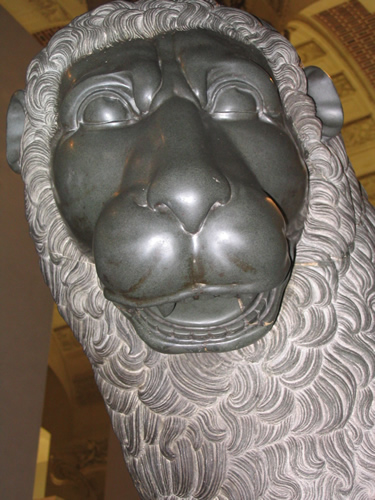
I think I found my lion friend in the same room:

He’s particularly engaging in closeup, although the picture doesn’t do him justice:

I spent a couple of hours wandering around the Decorative Arts, which I very much enjoyed. I don’t know how I missed it before. And I visited the Islamic Art collection, which is the newest and not yet complete addition to the Louvre’s permanent collections. There were some lovely pieces, but it doesn’t really come together well yet.

Tourist season has not begun in full force yet, but even on a weekday afternoon, the crowds are starting to mount up:

The public buildings in Paris, such as churches and palaces, never cease to amaze me. I have enormous difficulty wrapping my brain around constructing places on such a grand scale. The only thing comparable we have in the States are shopping malls. And will people still be going to, say, the Mall of America in a few hundred years? (Oh, Lordy: I hope not!)

Looking for more?

Add to Technorati Favorites


follow webgeekstress at http://twitter.com
Random books from my "Currently Reading" stack...