Posts Tagged ‘sightseeing’

Sunday
June
3rd
2007
4:56 am

Versailles, Revisited

There’s only one excuse for visiting Versailles on a summer weekend: to see the fountains in action. It’s too expensive to run the fountains all the time, so they’re only on for a few hours a day on weekends from April through September. (Versailles also charges admission to the gardens on these days; otherwise, entry is free.) There’s also a soundtrack of Baroque music, played by Le Concert Spirituel.

While I had enjoyed the gardens on the occasion of my earlier visit, being able to see the fountains in action made it ever so much better.

A smattering of the fountains, starting with the Apollo fountain:

The fountain in the Bosquet of the Pyramid:

The Dragon basin:

The fountain in the Bosquet de la Girandole:

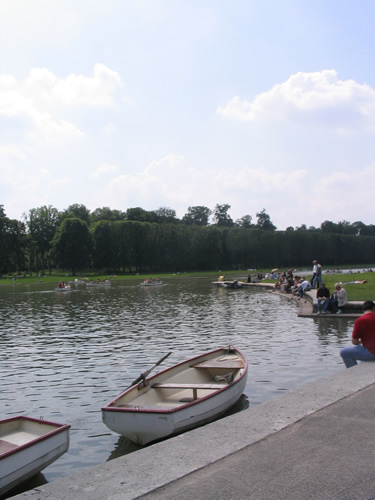
There were more people in the gardens this time (surprise, surprise), and the row boat rentals were open:

Pity they don’t have paddle boats, though, like the ones at Stow Lake.

Since I was there, though, I took advantage of the opportunity to visit the Dauphin’s apartments (which I hadn’t had time for before) and the apartments of Mesdames (which are open only on weekends), as well to spend a little more time in the gardens at the Petit Trianon:

Thursday
May
31st
2007
4:07 am

Fontainebleau

This week’s little excursion was to Fontainebleau, about 1/2 hour (by train) southeast of Paris.

The trip and Avon, where the station for Fontainebleau is located, are not particularly interesting. The suburbs of Paris through which the train passes look largely industrial; it doesn’t get pretty until after Melun. As for Avon, I suppose I really shouldn’t judge by what I could see from the bus, but I certainly didn’t see anything that made me want to linger.

The château has been there since the 12th century, and was used and renovated by kings and emperors through the Second Empire in the 19th century. Most of what remains now was built on what François Ier put in place in the 16th century, but very little is in an "original" form. There are rooms where the ceiling panels are from the time of François Ier, but the panelling on the walls dates to Louis XIV, while the furniture is from the reign of Napoleon III. (In fact, one of the artists who worked on the restoration painted DeGaulle and one of his ministers into some of the trim in the Hall of Trophies, so you could even argue that the renovations continued right on up to the Fifth Republic.)

The main approach to the Château is now across the Court of the White Horse (named for a statue that’s been gone since the 17th century); also known as the Court of Adieux, since it was from here that Napoleon made his farewells before going into his first exile.

The audio guide that’s included with the price of admission to the Château is very good, and quite complete. The guided tour, on the other hand, was pretty much a waste of time. It mostly covered rooms that are also done in the audio guide, and the tour guide was uninspiring. She seemed more interested in getting the tour over with.

The gardens are lovely, through: spacious and green, with lots of fountains and ponds. I don’t quite get what’s going on with the topiary cones, though.

The carp pond in back of the Château has this little pavilion in the middle, where the King could entertain his mistress. One hopes that they remembered how well sound carries over water!

And a view of Fontainebleau from the far side of the carp pond.

Wednesday
May
30th
2007
12:07 pm

Musée Rodin

Last week’s sightseeing trip was a visit to the Musée Rodin, one of my favorites. They had just opened a new exhibit, Le Rêve Japonais (The Japanese Dream), which includes both Japanese selections from Rodin’s private collection as well as Japanese inspired works of Rodin.

I was not all that blown away by the exhibit, although that says more about my tastes than the exhibit. The reason I really visit the Rodin is to wander in the garden and visit my favorite sculptures. The Thinker, for example:

Or The Burghers of Calais, which is just heartbreaking:

The Three Shades I find fascinating: it’s three of the same figure, just turned differently:

And of course, I could pour over The Gates of Hell indefinitely:

Saturday
May
26th
2007
1:03 pm

Chartres

I took a little day trip down to Chartres on Wednesday the 16th.

It’s an hour out of Paris by train, through some very green and lush country. Aside: each time I leave Paris, I return a little more dissatisfied with pavement and stone buildings.

The Cathedral is a prominent landmark: you can see it about 10 minutes before arriving in Chartres, and it’s easy to hone in on once you arrive. It’s also close enough to train station that I could easily remember how to get back!

When visiting the cathedral, Malcolm Miller’s tour is a must (at least for Anglophones). He’s 73 now, and literally wrote the book (Chartres Cathedral). He’s been giving tours twice daily (noon and 2:45) during the spring and summer at the cathedral since 1956; during the winter, he tours and gives lectures. I took his tour on my first visit 20 years ago. Back then, he solicited tips at the end of his tour; now, at the prompting of the government, which wants to be able to collect taxes, he charges a 10€ fee up front. (Well, that’s how he explains it, anyway.)

At the time of my first visit, the government had just barely started cleaning and restoring the stained glass windows. Now, twenty years later, they’ve made impressive progress, and I’d estimate that a good half of the windows (it looks as though all of lower tier windows, as well as the west and north rose windows and some other of the upper tier windows) have been done. Perhaps if I return in another 20 years, they’ll all be done!

They’ve also started cleaning the outside: the north entrance is done, and the south entrance is about to be shut and cordoned off so that they can restore that one. The north entrance, all cleaned up:
North entrance, Chartres cathedral

I showed up for both tours, as did a few other visitors, so Miller very thoughtfully changed his spiel so that we wouldn’t be bored. During the noon tour, for example, he walked us through the west rose window (left below), with its story of the Passion, the Nativity story, and the Jesse tree, going from left to right below the " rose"; during the 2:45 tour he walked us through the north rose window (right below), with St. Anne in the center, flanked by Old Testament patriarch below the rose. (We know it’s St. Anne holding Mary, and not Mary holding Jesus, he explained, because the child’s halo doesn’t have the cross that marks Jesus. Not that you can pick up that detail from the picture.)

The dedication of the Cathedral at Chartres to Our Lady predates the trend of Marian devotion that started in the 12th century. As a result, when the king of France received a significant Marian relic, Chartres, as the nearest major church devoted to Mary, became the beneficiary of the Sancta Camisa, which is alternately described as having been the garment that Mary wore at the time of the Annunciation or at the time of the Birth of Jesus. When the reliquary was opened, though, it was found to be a length of silk that reportedly does indeed date back 2000 years.

The presence of the Sancta Camisa made Chartres a major pilgrimage center. Conveniently enough, it was also on one of the major routes to Compostella, another favorite destination for pilgrims. And so, in the pavement around Chartres, you can find these reminders of the past: mosaics of pilgrims and the shell of St. James, the patron of Compostella.

I didn’t have much opportunity to explore the rest of Chartres. Like most French cities, though, it does have its war memorial:

Tuesday
May
8th
2007
8:01 am

Musée d’Orsay

I’m not much of one for art museums. In particular, I don’t much care for painting. It’s just too flat for my tastes. I prefer more tactile art forms, such as sculpture and metal work. However, I’ve been hearing a lot about La Forêt de Fontainebleau (The Forest of Fontainebleau) exhibit, and I decided to head over to the Musée d’Orsay and check it out.

Because this is an exhibit that focuses on the setting rather than the artist, there was a wide variety of art, spanning both different styles and different media (oil, watercolors, pen and ink, even photography and film). As a result, I enjoyed it more than I had expected to.

After the exhibit, I wandered around the rest of the museum, where I found sculpture and some Art Nouveau pieces that are part of their permanent collection. These were even more to my taste, though I didn’t find anything that I actively coveted. Well, maybe Fremiet’s St. Michael, but what would I do with a life size St. Michael? No, much better to let the d’Orsay keep it for me.

Looking for more?

Add to Technorati Favorites


follow webgeekstress at http://twitter.com
Random books from my "Currently Reading" stack...