Posts Tagged ‘sightseeing’

Tuesday
April
29th
2008
2:30 pm

Pottery Making Market at Nelahozeves

While I was at Prague Castle on Saturday, in my failed attempt to get a look at the Czech Crown jewels, I happened to run across a flyer advertising a “Pottery Making Market at Nelahozeves”. Nelahozeves is a Renaissance château a little ways north of Prague; it’s been restituted to the Lobkowicz family. The town of Nelahozeves is also known for being the birthplace of Antonín Dvořák. So, on Sunday, rather than get up at some ungodly hour to stand in line at Prague Castle, I took the train up the river to Nelahozeves.

There were several dozen stalls, in the outer courtyard, in the approach to the château, and in the inner courtyard, most, but not all, of which were selling pottery or ceramics. There was also a grassy area which was mostly dedicated to games and demonstrations. And, of course, plenty of (not too outrageously overpriced) food and drink. This being the Czech Republic, there was sausage and potato pancakes and goulash and beer.

They were also running the regular tour of the château. There was no English language tour, though; instead, they gave me a pamphlet with the English text of the tour and sent me off with a Czech group.

Since I was in the neighborhood, I wanted to get a look at Dvořák’s birthplace, but it’s open only alternate weekends, and this wasn’t one of those weekends. (You’d really think they could have coordinated this better!).

I took enough photos that, rather than include them in this posting, I’ve put them into a slideshow.
Tuesday
April
29th
2008
2:14 pm

(Not) Seeing the Czech Crown Jewels

The Czech crown jewels are not on permanent display, but are trotted out only once every few years, and the current display marks the first time in five years that they have been shown.

I had heard that, at the time of the last display, so many people lined up that the line was being closed by 11 AM (for an exhibit that closes its door to visitors at 5 PM), so I made a point of heading to Prague Castle at 9 AM on Saturday morning, only to find that the line, for an exhibit that opened at 9 AM, was already closed for the day. According to the Prague Post, people were getting in line at 3 in the morning! Given the popularity of the exhibit, I really don’t understand why the government doesn’t put the jewels on more frequent, if not permanent, display.

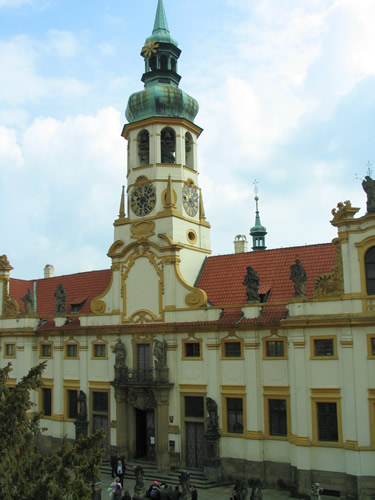
Since I wasn’t able to see the crown jewels but was in the general vicinity, I did pay a visit to the Loreto, which houses a replica of the Santa Casa in Loreto, Italy. (I highly recommend the website’s virtual tour.)
Loreto, Prague
Reportedly, the Loreto was built during the 17th century as part of the Catholic campaign to attract the Czechs back to Catholicism.

Besides the Church of the Nativity and the Santa Casa, the complex houses a treasury which was well worth the visit. The most stunning piece on display was a diamond-encrusted monstrance known as the Prague Sun.

The entrance fee of 110 CZK is waived for priests and religious, which I thought a charming professional gesture.

I’m told by one of my students that replicas of the crown jewels are on permanent display at Karlštejn (a castle near Prague), so I suppose I’ll have to make the trek out there one of these days. It won’t be quite the same, but at least I’ll get a rough sense of what I missed.

Saturday
April
19th
2008
2:13 pm

Another Weekend, Another Castle

Once again, I turned to my handy little guidebook for ideas on where to go outside of Prague, and this time I settled on Křivoklát. Its appeal is that it was described as a sort of "living museum of medieval life and crafts". Reportedly, there are resident artists and craftsmen whose products are for sale.

To get there, I took the train to Beroun, then transferred to the train for Křivoklát. The train to Beroun is the one also taken by visitors to Karlštejn, so the train nearly completely emptied out there.

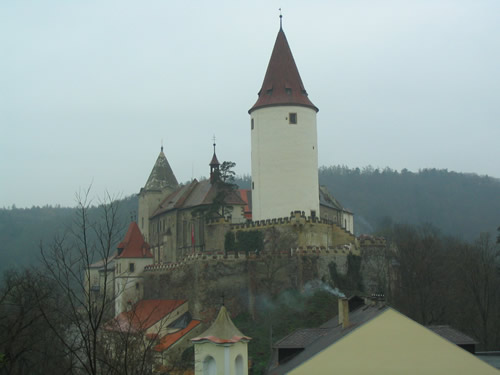
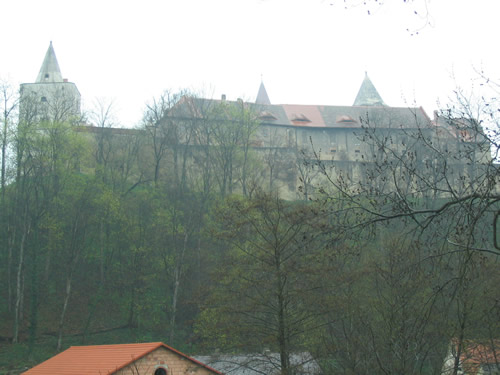
Křivoklát started as a hunting lodge before being converted into a more defensible structure, so it’s considerably less ornate than many other Czech castles. As seen from the train station:
Krivoklat
And the view from an adjoining hillside:
Krivoklat

Perhaps because it was a weekend, I don’t know that I saw any of the reputed resident artists or craftsmen. Their works, though, were indeed available for sale, and while there wasn’t a whole lot, what there was was varied and much more interesting than the usual tourist fare. There was wood work and metal work, fabrics, paintings, products made with honey and with bees’ wax.

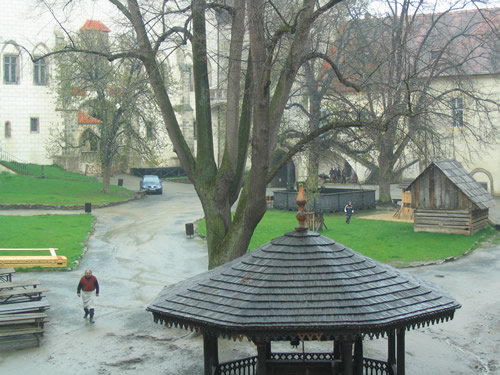
There weren’t many people about at all; that it was pouring rain probably had something to do with that! The inner courtyard:
Krivoklat courtyard
There was one couple who were getting married at the castle, although from what little I could see of the room reserved for that purpose, it hardly seemed a romantic setting. And after the wedding, the wedding party turned out in the courtyard for pictures, with umbrellas overhead and the poor bride trying to keep the hem of her white gown out of the mud.

At this time of year, there was no English-language tour of the interior available; instead, I was given a folder with the text of the tour and sent off to join the Czech tour. The covers were color-coded, so I could tell that there were two other English-speaking couples and one German couple. The interior was not particularly noteworthy, although there was a very nice chapel. There is also a dungeon with an impressive display of torture equipment.

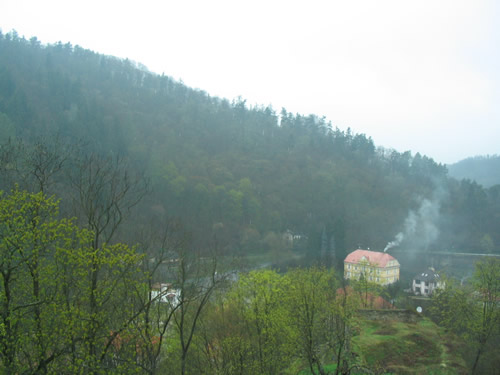
The countryside is lovely, and it would be worth coming back just to wander in the hills:
Krivoklat
I had time to kill before the train came, so I hiked around a little, but the persistent rain (oh, and I was umbrella-less) discouraged me from going too far.

Sunday
April
6th
2008
3:56 am

Day Trip to Melník

I haven’t been out of town for a couple of months, not since my January trip to the Butter Museum at Máslovice. So I pulled out my little guidebook and started paging through the section on day trips, where I ran across a description of Mělník. So I hopped on the bus to have a look.

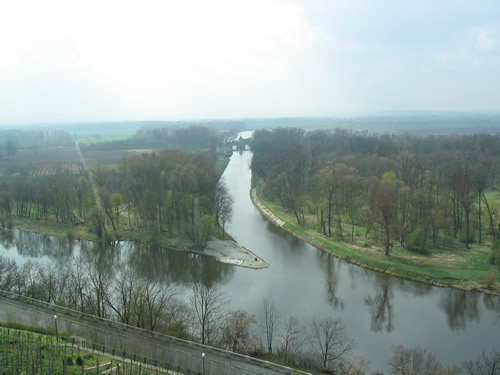
The castle (of course there’s a castle: this is a Czech town) is beautifully situated, on a hill overlooking the confluence of the Vltava and Labe rivers:
View of the Vltava and Labe rivers from Melnik
This view is said to be the inspiration for Smetana’s Ma Vlast ("My Country"). The castle was confiscated from the Lobkowicz family by the communists, but has since been returned to them.

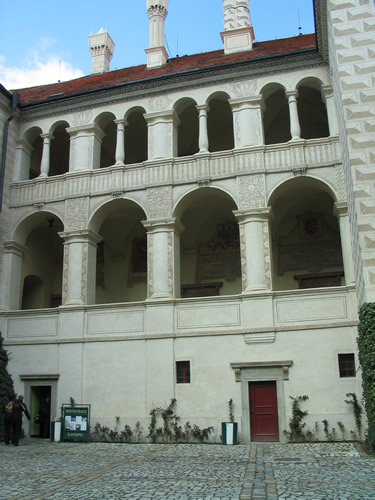
From the castle courtyard; in the lower left is the entrance to the restaurant:
Courtyard of Melnik Castle
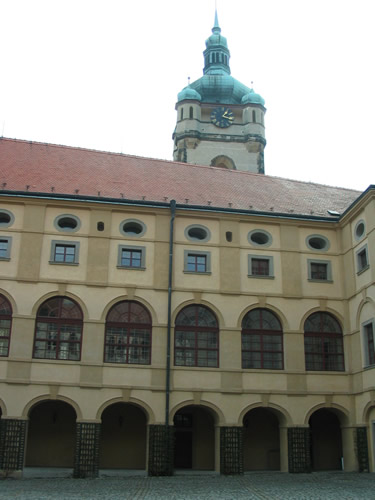
And the opposite side of the courtyard:
Courtyard of Melnik Castle
That’s the spire of the Cathedral of Sts. Peter and Paul in the background.

The castle has been well-restored and the tour was interesting. As an aside, I’ll point out that, by and large, it’s the castles that have been returned to private hands that have been better restored and that have better tours. The ones operated by the government have largely been gracelessly restored and the tours are more boring.

The Cathedral of Sts. Peter and Paul has an ossuary that a Czech professor designed with a group of his students back in 1914. Once you’ve seen the ossuary at Sedlec, though, this one is a snoozer!

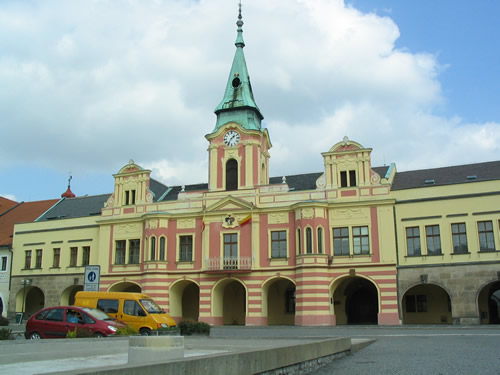
There’s really not much else to see in Mělník. The City Hall on the main square is attractive, but not worth a trip:
Melnik City Hall

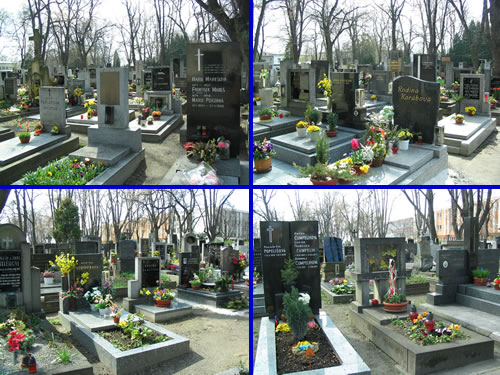
On my way back to the bus stop, I happened to pass by a cemetery, and decided to take a peek:
Melnik Cemetery
I was really surprised, and touched, that it seemed that all of the graves were decorated with potted flowers. It was only when I noticed the pomlázka decorating one of the arrangements that I realized that this must be an Easter-specific tradition. Even so, it was impressive that each grave apparently had someone still caring for it.

Saturday
March
8th
2008
1:07 pm

Prague Zoo and Trojský Zámek

The winter weather has been making me restless, but of late, it has turned relatively mild. It’s still too early in the year to venture outside of Prague, so I turned my thoughts to sights within Prague that I’ve not yet visited. On consulting with some of my students, I was advised to check out the Zoo, Troja Château, and the Botanical Gardens. This sounded like a pleasant excursion, so I took myself off to Nádraží Holešovice and the bus for the Zoo.

Now I must say at the outset that I’m no great fan of zoos: I always feel so sorry for the animals. However, the Prague Zoo is very nicely laid out, and the animals have plenty of space. I still worry about the predators especially: some of the big cats were looking very restless, and I can’t say as I blame them. I particularly enjoyed visiting the penguins and the gorillas: their pavilions are very nice.

Since it was so early in the season, it wasn’t very crowded, although a good number of families were taking advantage of the relatively mild day to have an outing.

The amount of space given the animals means that the zoo is very large, and even after five hours wandering around, I think I saw only about 2/3 of it. But I was getting tired of animals and had other stops on my day’s itinerary.

Conveniently enough, Trojský Zámek is just across the road from the main entrance to the zoo. The grounds are perfectly lovely: I’d like to come back later in the Spring to enjoy them in their full glory. I had to wait for about half an hour for the next tour of the zámek, so I had ample opportunity for strolling the grounds.

The tour was rather disappointing. While the architecture is lovely, I was unimpressed by the exhibits. The art struck me as rather pedestrian. I also thought that the ceiling frescoes had been badly restored: the colors were too strong and had been applied without subtlety. The resulting frescoes looked like the products of paint-by-numbers kits.

Language Note

Zámek is usually translated château, which of course is just French for "castle", while hrad is usually translated "castle". So what, I asked one of my students, is the difference between a zámek and a hrad? Well, he told me, a hrad is a stone, defensive structure, usually Gothic, while a zámek is a later, more luxurious, less defensive building. Fair enough, but then what is the difference between a zámek and a palác ("palace", predictably enough). Well, a palác is usually within the city limits and has no grounds, whereas a zámek has extensive grounds and is usually located on the outskirts of the city, if not actually in the country. Zámek is sometimes translated as "villa", which strikes me as more accurate.

There’s also a wine museum: it’s small, but interesting. It describes the viticulture of Bohemia and Moravia, and offers a wine shop. I didn’t buy anything, though.

By the end of my visit to the zámek, it was nearly 5:00, so I decided to save the Botanical Gardens for another visit…

Looking for more?

Add to Technorati Favorites


follow webgeekstress at http://twitter.com
Random books from my "Currently Reading" stack...