Posts Tagged ‘Czech Republic’

Saturday
April
19th
2008
2:13 pm

Another Weekend, Another Castle

Once again, I turned to my handy little guidebook for ideas on where to go outside of Prague, and this time I settled on Křivoklát. Its appeal is that it was described as a sort of "living museum of medieval life and crafts". Reportedly, there are resident artists and craftsmen whose products are for sale.

To get there, I took the train to Beroun, then transferred to the train for Křivoklát. The train to Beroun is the one also taken by visitors to Karlštejn, so the train nearly completely emptied out there.

Křivoklát started as a hunting lodge before being converted into a more defensible structure, so it’s considerably less ornate than many other Czech castles. As seen from the train station:
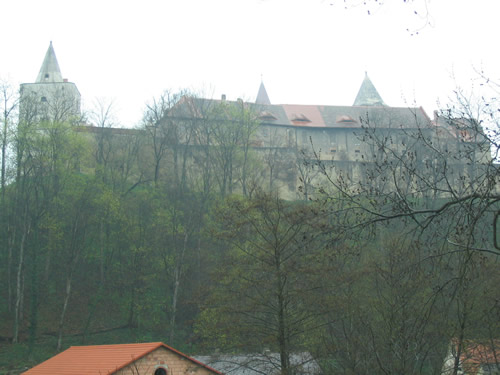
Krivoklat
And the view from an adjoining hillside:
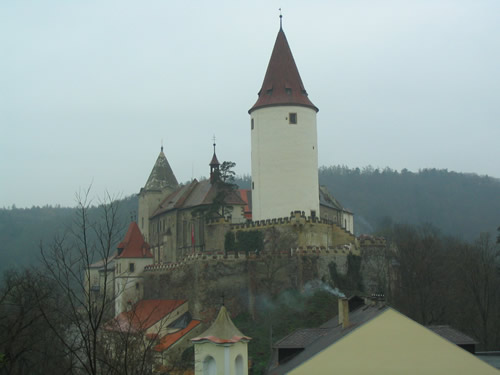
Krivoklat

Perhaps because it was a weekend, I don’t know that I saw any of the reputed resident artists or craftsmen. Their works, though, were indeed available for sale, and while there wasn’t a whole lot, what there was was varied and much more interesting than the usual tourist fare. There was wood work and metal work, fabrics, paintings, products made with honey and with bees’ wax.

There weren’t many people about at all; that it was pouring rain probably had something to do with that! The inner courtyard:
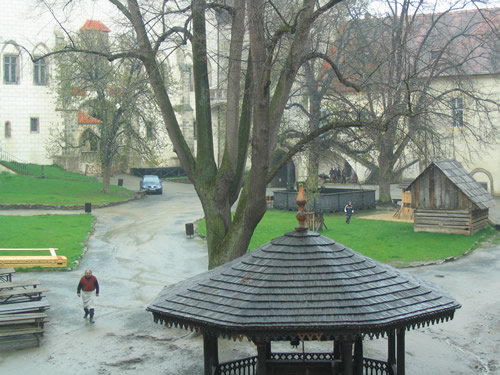
Krivoklat courtyard
There was one couple who were getting married at the castle, although from what little I could see of the room reserved for that purpose, it hardly seemed a romantic setting. And after the wedding, the wedding party turned out in the courtyard for pictures, with umbrellas overhead and the poor bride trying to keep the hem of her white gown out of the mud.

At this time of year, there was no English-language tour of the interior available; instead, I was given a folder with the text of the tour and sent off to join the Czech tour. The covers were color-coded, so I could tell that there were two other English-speaking couples and one German couple. The interior was not particularly noteworthy, although there was a very nice chapel. There is also a dungeon with an impressive display of torture equipment.

The countryside is lovely, and it would be worth coming back just to wander in the hills:
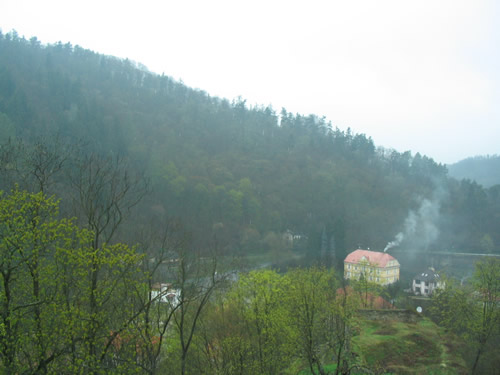
Krivoklat
I had time to kill before the train came, so I hiked around a little, but the persistent rain (oh, and I was umbrella-less) discouraged me from going too far.
Sunday
April
6th
2008
3:56 am

Day Trip to Melník

I haven’t been out of town for a couple of months, not since my January trip to the Butter Museum at Máslovice. So I pulled out my little guidebook and started paging through the section on day trips, where I ran across a description of Mělník. So I hopped on the bus to have a look.

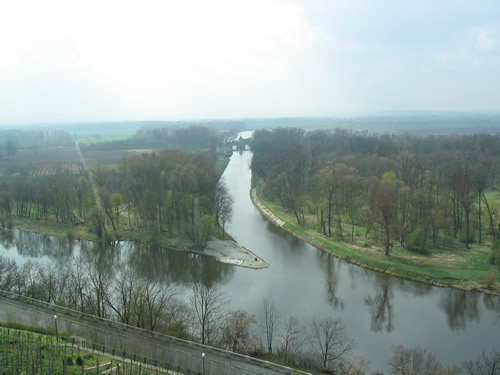
The castle (of course there’s a castle: this is a Czech town) is beautifully situated, on a hill overlooking the confluence of the Vltava and Labe rivers:
View of the Vltava and Labe rivers from Melnik
This view is said to be the inspiration for Smetana’s Ma Vlast ("My Country"). The castle was confiscated from the Lobkowicz family by the communists, but has since been returned to them.

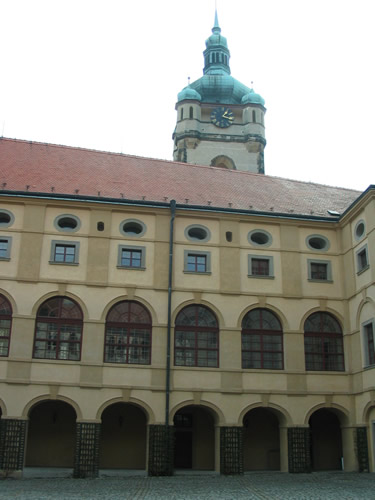
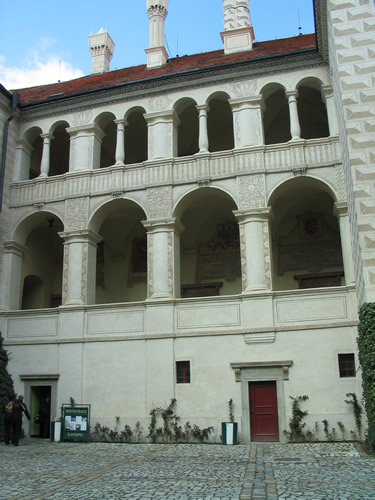
From the castle courtyard; in the lower left is the entrance to the restaurant:
Courtyard of Melnik Castle
And the opposite side of the courtyard:
Courtyard of Melnik Castle
That’s the spire of the Cathedral of Sts. Peter and Paul in the background.

The castle has been well-restored and the tour was interesting. As an aside, I’ll point out that, by and large, it’s the castles that have been returned to private hands that have been better restored and that have better tours. The ones operated by the government have largely been gracelessly restored and the tours are more boring.

The Cathedral of Sts. Peter and Paul has an ossuary that a Czech professor designed with a group of his students back in 1914. Once you’ve seen the ossuary at Sedlec, though, this one is a snoozer!

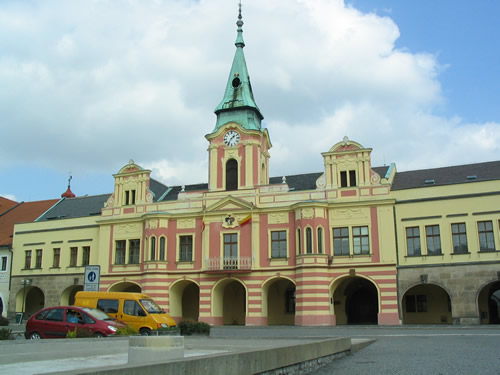
There’s really not much else to see in Mělník. The City Hall on the main square is attractive, but not worth a trip:
Melnik City Hall

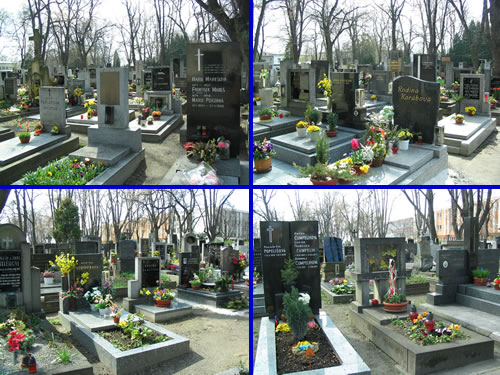
On my way back to the bus stop, I happened to pass by a cemetery, and decided to take a peek:
Melnik Cemetery
I was really surprised, and touched, that it seemed that all of the graves were decorated with potted flowers. It was only when I noticed the pomlázka decorating one of the arrangements that I realized that this must be an Easter-specific tradition. Even so, it was impressive that each grave apparently had someone still caring for it.

Sunday
March
23rd
2008
3:24 pm

Liturgical Anthropology: Triduum

I was half expecting quadrilingual liturgy for Triduum, much as we had for Palm Sunday, but in fact, for Holy Thursday and Good Friday, we had strictly English language liturgies. The Spanish speaking community had their liturgies in St. Barbara’s Chapel, just off the cloister garden, and I have no idea where the Czech community ended up. And for Easter Sunday, we had our usual schedule of three Masses, one for each community. For Easter Vigil, though, we did indeed have a Czech-Spanish-English-Latin mix, similar to that of Palm Sunday.

Holy Thursday and Good Friday

The liturgies on Holy Thursday and Good Friday were largely unremarkable. I was glad to see, though, during the ceremony of the washing of feet that Sv. Tomáš does not follow the practice of having only men come forward. Instead there was a mix of men and women, and even one child. There were, however, only 6 washees; I’m not sure why we didn’t have the full complement of 12.

The only place where the Good Friday service departed from the norm was in the timing: it took place at 6:30 PM rather than mid-day. I think this was probably a concession to the fact that in this largely atheistic city, it would be difficult for working people to attend a mid-day service. I was disappointed, though, as I had wanted to attend a performance of Dvořák’s Stabat Mater that had been scheduled for that evening at Národní Divadlo.

Easter Vigil

As at Palm Sunday, the quadrilingual nature of the service made it difficult to follow along, and I’m seriously disappointed with the way in which Sv. Tomáš handles this. I’m thinking that, next year, I’m going to give serious consideration to making a Triduum retreat in an English-speaking country.

It was gratifying to see, though, the number of people being received for Baptism: there were eight Czech neophytes and two from the English-speaking community. And that’s the only thing that would hold me back from going on a retreat instead: a Vigil without Baptism would seem rather hollow.

At the conclusion of the Vigil service, we had a "Theophoric Procession", which was described to us as a Czech tradition. (I had to look "theophoric" up myself: it’s from the Greek meaning "bearing a deity".) The presiding priests and the altar servers went in procession to St. Dorothy’s Chapel, which had been used as the Reservation Chapel following Holy Thursday’s Transfer of the Sacrament. They knocked at the door of the Chapel, which opened to reveal a statue of the resurrected Jesus. The statue was then carried in procession, followed by the community, out of the church, around the cloister gardens, and back into the church, where the statue was left at the altar, by the ambo.

Easter Sunday

For the Easter Sunday Mass, we again had not only a Theophoric Procession, but an "Encuentro" (Spanish for "encounter"). This is a tradition borrowed, obviously enough, from the Spanish. In this particular version, while the men of the community were invited to process behind the statue of the resurrected Christ, the women were invited (though not obliged – Father William was very careful about that!) to follow a black-draped statue of Our Lady out through a different door of the church and around the cloister gardens, in the opposite direction traced by the Theophoric Procession. Our two groups met in front of St. Barbara’s Chapel, and the statue of Our Lady was unveiled, representing the first post-resurrection meeting between Jesus and His mother. We then completed our circuit of the gardens and returned to the church, where the statue of the resurrected Christ was returned to its place near the ambo while the statue of Our Lady went to the opposite side of the altar.

Saturday
March
22nd
2008
8:37 am

Easter Markets and Pomlázky

Easter Markets

I was curious to know if Easter Markets were substantially different from Advent Markets. There are really only trivial differences. They’re smaller, for one; in fact, Náměstí Míru didn’t even have one. Most of the stalls sell the same touristy junk that they sold before Christmas, and the food and drink are largely the same. In particular, the trdelník stalls are hugely popular:
Trdelnik
It’s fun to watch trdelník being made. They start with sweet yeasted bread dough. The baker rolls a chunk of dough into a long snake, which is then wrapped around a stainless steel cylinder. After two or three snakes have been wrapped, the cylinder serves as a rolling pin to flatten the dough while it’s rolled in a mixture of coarse, spiced sugar and almonds. The dough-covered cylinder is then set in a rack that spins the cylinder over an open fire so that the dough bakes and the sugar caramelizes. When the trdelník is all nice and toasty brown, it comes off the fire and is rolled once more in the sugar and almond mixture. Needless to say, they’re best hot off the fire.

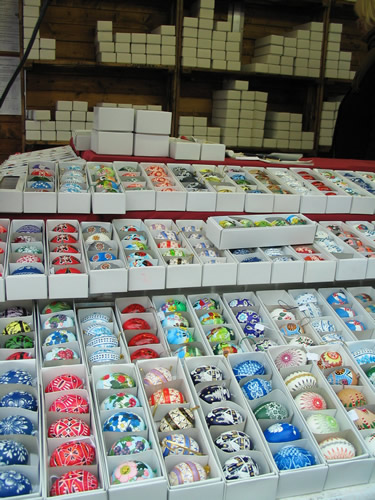
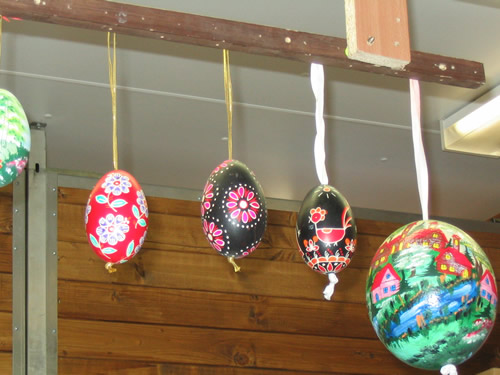
The main place where the Easter markets differ from the Advent markets is that the Christmas decorations are (mostly) replaced by decorated eggs:
Easter eggs

Easter eggs

Easter Market at Anděl

The Easter Market at Anděl is a small one: just a couple of dozen stalls. What I like about it, though, is that it has a pony ride:
Pony ride at Andel
It also has a couple of other rides for children. There’s a choo-choo train:
Children's train ride at Andel
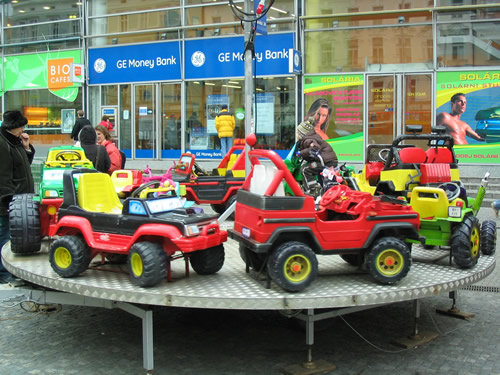
And there’s a car ride:
Children's car ride at Andel

Easter Market at Staroměstské Náměstí

The big Easter market, at Staroměstské Náměstí (Old Town Square), on the other hand, has a much larger collection of stalls. In addition, there’s a sort of little petting zoo:
Petting Zoo
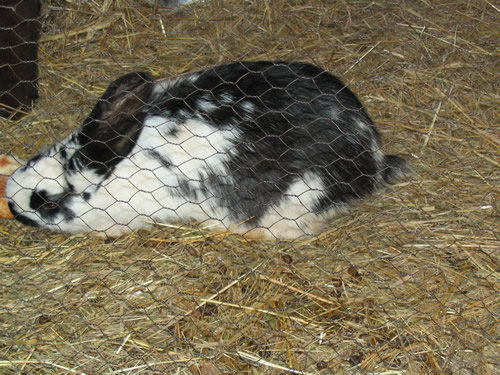
The Easter Rabbit?
Easter Rabbit?
There’s also a blacksmith at work:
Blacksmith
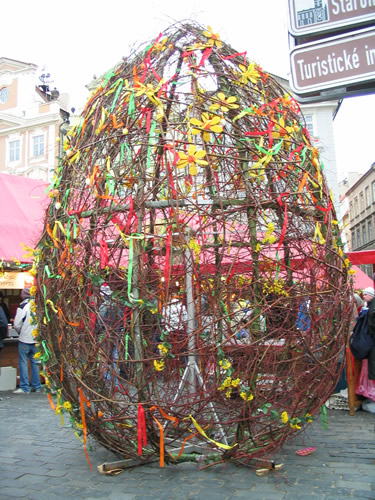
Instead of a Christmas tree, there’s an Easter egg:
Easter egg
There’s also an Easter tree (there, behind the Jan Hus memorial):
Easter tree

Florists and Pomlázky

A few weeks ago, I started seeing these bundles of twigs trimmed with multi-colored ribbons at florists’ stands:
Pomlazka
I asked one of my students about them, and he became a little flustered and claimed (rather disingenuously) that they’re just a traditional Spring decoration. It took me a while longer to find out that they are supposed to be used on Easter Monday, when the men whip the women to keep them beautiful and/or fertile. Not surprisingly, the men in my classes all disclaim any participation in this pagan ritual: "It’s practiced only in some of the smaller villages these days", they tell me. And according to this article from the Prague Post, they may be correct. However, several of my women students have admitted that their husbands or boyfriends have brought home their pomlázky, which will be used for the traditional purpose. (I’m staying out of this: they’re consenting adults and I’ve no reason to believe that any of these women is in an abusive relationship.)

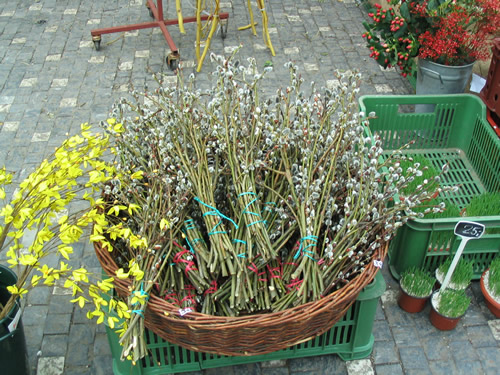
And, it turns out that pussy willows aren’t just for Palm Sunday:
Pussy willows

Sunday
March
16th
2008
1:13 pm

Liturgical Anthropology: Palm Pussy Willow Sunday

Preliminary Note About Sv. Tomáš

I should preface this by explaining a little bit about Sv. Tomáš (St. Thomas’). The Church and monastery of Sv. Tomáš was established in 1285 by King Vaclav II, and we still pray for him every Sunday. It’s in Malá Strana and is staffed by Augustinians. Apparently the neighboring churches of Sv. Josef and Panny Marie Vítězné (Our Lady Victorious; home of the statue of the Infant of Prague) are also part of the parish, although I don’t understand how that works.

Besides being the official home of the English-speaking Catholic community in Prague and home to a Czech-speaking community, there is also a Spanish-speaking community that makes its home here. Mostly this isn’t much of an issue. On Sundays, there’s a Czech Mass at 9:30; the English Mass is at 11:00; while the Spanish Mass is at 12:30. On Christmas, it got a little more complicated, and the "Midnight Mass" in English actually took place at 6:00 PM, which I didn’t realize until after the fact and so it was that I attended the Czech Midnight Mass.

Palm Sunday

For Palm Sunday, then, the three communities that make up Sv. Tomáš had a joint celebration that started at 9:30 at Panny Marie Vítězné. When I arrived at the church, there was a donkey on the lawn in front of the church, placidly enduring the curious tourists with their cameras.

At the door of the church, attendants were handing out not palms, but pussy willow branches. Which makes more sense than importing palms, although the mental picture of throngs lining the road into Jerusalem with pussy willows and waving them as they sing their "Hosanas" makes me smile. (Last year, at Sacré Cœur, we didn’t receive palms either; instead, we got green branches of some kind – laurel, maybe?)

When the service started, we had opening prayer in English, Czech, and Spanish; the Procession Gospel was proclaimed each of the three languages; and the branches were blessed three times: once in each language. One of the boys of the parish was there, in a red hooded cloak; he was the "stand-in" for Jesus and was mounted on the donkey. We then wended our way in procession through some back streets of Malá Strana to Sv. Tomáš. Once there, I saw the main doors of the Church thrown wide open for the first time to allow our mounted "Christ" to go right up to the altar, where he dismounted. (I didn’t notice, but I’m guessing that the donkey was led into the cloister gardens.)

Once the Mass proper started, we had a quadrilingual (Czech, Spanish, English, and Latin) liturgy, with the languages trading off rather than prayers and readings being repeated. From a pastoral point of view, of course, it makes perfect sense. However, I was disappointed by the way in which it was implemented. Maybe I’m just spoiled, but the Oakland diocese certainly knows a lot more about how to put on a multi-lingual liturgy! As it was, it was impossible to fully participate in, and difficult even to follow, the non-English parts of the liturgy. I must say, though, that the Czech choir is absolutely exquisite!

The language issue aside, the Mass was unremarkable, except that Communion was given by intinction (i.e., the minister dipped the Host in the Chalice before placing the Host on the communicant’s tongue). The only other time I’ve seen that done was at Sacré Cœur last year, at the Mass of the Lord’s Supper. But at Sacré Cœur, they usually don’t offer Communion under both species, while at Sv. Tomáš, they always do, so this departure from the norm seemed rather odd to me.

Looking for more?

Add to Technorati Favorites


follow webgeekstress at http://twitter.com
Random books from my "Currently Reading" stack...