Posts Tagged ‘Czech Republic’

Monday
September
1st
2008
8:51 am

Week in Frantiskovy Lazne

After my birthday weekend in Mariánské Lázně, I was curious about what the real spa experience was supposed to be like. And I was also in the mood to get out of Prague for a little while. So, I booked myself a one-week stay in Františkovy Lázně. Of the three main spa towns in that district, Františkovy Lázně is the least well-known (and the smallest); Karlovy Vary is the best-known, with Mariánské Lázně coming in between.

It’s a very pretty town, with extensive parks:


There’s even a "miniature golf course":

This is the first miniature golf course I’ve seen in the Czech Republic.

One of the parks has a bandstand which was host to a (free) afternoon concert:

The official color scheme of Františkovy Lázně, or at least the spa district, is yellow and white. It’s very stylish, but it starts to get a little boring after a while. I forget which hotel this was:

The Catholic church, which was also home to a very nice concert one evening:

The colonnade, with its attendant sphinxes:

And where is it written that all Czech spa towns must have a colonnade?
The Božena Němcová Theater does not follow the yellow and white rule. Though it’s not readily apparent from this shot, the theater is actually pale green and white:

I was staying at the Hotel Imperial:

It’s not as big as the picture makes it look: it’s only a few dozen rooms, but it is, for Františkovy Lázně, very grand. English was in short supply, although the clerks at the front desk managed to get by pretty well, and the doctor spoke surprisingly good English. (On my last visit, she asked what I did for a living. When I said that I’m an English teacher, she exclaimed that that was why I spoke so slowly and carefully and was so easy to understand. She was touchingly grateful that I was so easy to communicate with. It made me wonder what her experience with other English speakers had been like.)

As at Mariánské Lázně, the treatments were very clinical: the treatments rooms feature lots of white paint and tile and bright lights, and the attendants are all in white uniforms. It’s not at all like the muted and tranquil environment that I usually associate with days spas in California.

The treatments I had were pretty ordinary: baths and massages and one mud wrap. The one treatment that I found novel was the "underwater massage". In this one, the attendant uses a high-pressure hose to do the massaging. Kind of like an hand-held shower massage, but dialed up about a hundred-fold!

It was a relaxed week, though. I walked a lot and caught up on some reading. (The limited Internet service coupled with a problem with my computer’s power supply kept me largely offline for the week.)

Saturday
July
12th
2008
12:02 am

Visit to Cesky Krumlov

I finally visited Český Krumlov after putting it off several times. While it’s possible to visit as a day trip out of Prague, it takes about three hours to get there, and the prospect of spending a total of six hours in one day sitting on a bus was not appealing. So instead, I took the Student Agency bus down for an overnight trip.

The seal of Český Krumlov:

And the sight for which it is perhaps best known, the Little Castle and Tower:

Touring the Castle and Grounds

The castle complex is the second largest in the Czech Republic, Prague Castle being the largest. It has some 40 buildings spread out over a kilometer of a hillside overlooking the Vltava River. Just crossing from the Red Gate, the main entrance near the town, up to the gardens took about half an hour.

The former Mint is now the ticket office and main gift shop:

Across the second courtyard from the Mint is the New Burgrave:

Those aren’t really stones joined with mortar, nor are there niches with statuary. That trompe-l’œil effect is created with sgraffito. There’s a lot of sgraffito and frescos decorating the castle exteriors.

Looking back to the Little Castle and Tower from the path to the gardens:

The Gardens

The gardens alone cover 11 hectares (ca. 27 acres). There’s a fountain, of course:

And looking at the fountain from behind:

I think it very thoughtful of them to provide a little step ladder, the better to get a good view of the garden:

Although, even with the stepladder’s help, I couldn’t get a really good perspective of the garden:

The gardens are also home to a Revolving Theater. While the theater itself didn’t yield any interesting shots, I liked seeing these set bits lying on the grass:

The Castle Bears

According to the castle website, bears have been kept in the moat of the castle since the 16th century, during the era of the Rožmberk family. The family claimed descent from the Italian Orsini family, whose emblem was the bear, and so the Rožmberks kept bears to emphasize the relationship.

The moat is divided in two by the bridge, with Kateřina and Vok to the left and their daughter Marie Terezie to the right.

Marie Terezie takes her duties as guard bear seriously:

I can’t tell if this is Kateřina or Vok, but it appears that Marie Terezie’s parents are less serious about protecting the castle:

I like the way in which they politely discourage people from feeding the bears:

And keeping watch over the bears, we have St. Joseph (on Marie Terezie’s side):

While Our Lady keeps watch on Kateřina and Vok’s side:

The Tours

There are three guided tours of the castle, of which I managed to complete only two (leaving a tour of the theater for another visit, I guess). We heard the stories of the various families who owned the castle, starting with the Rožmbrks (1302-1602), followed by the Eggenbergs (1622-1719), until it was passed on to the Schwarzenbergs (1719-1947). It was nationalized in 1950 by the Communists. Following the Velvet Revolution, it was offered back to the Schwarzenbergs, but conditional upon their assuming responsibility for restoring it. They declined the offer.

As do so many castles, this one has a “White Lady”. Here, it’s Perchta of Rožmberk. Perchta was unhappily married to a much older, abusive husband, Jan of Lichtenstein. On his deathbed, Jan repented of his many cruelties and asked Perchta’s forgiveness. When Perchta refused, he cursed her instead. As a result, she now haunts the former Rožmbrk residences, especially this one. If she appears wearing white gloves, good news is in the offing. However, if she’s wearing black gloves, it’s a death omen. The tour guide claimed that one of her colleagues had recently reported a sighting of the White Lady. However, she went on to say, he was drunk that night, so no one believes.

There are lots of bearskins rugs in the castle: while I vaguely noticed this, I didn’t really pay it any mind until the tour guide brought it to our attention. “These are the bears from the moat”, she told us. For some reason, that really creeps me out.

Besides the Castle, There’s the Town…

In addition to visiting the castle, I took the audio guided self-tour of the town.

The Marian Plague Column in the Main Town Square is under renovation:

Krčín House is notable mainly for its sgrafitto and frescos:

And round the corner…

If I remember correctly, this was the house of Sheriff Slatinský:

Farewell

And a last look on my way back to the bus stop:

I’ve put some additional photos into this slideshow.

Saturday
July
5th
2008
2:01 pm

The Poor Czechs…

Today is the Day of Slavonic Apostles Cyril and Methodius, and it would be a work holiday if it weren’t a Saturday. And tomorrow’s Jan Hus Day would similarly be a holiday from work if it weren’t a Sunday.

The next holiday on the books is September 28’s Day of Czech Statehood, but that falls on a Sunday this year, so again, no day off of work. There won’t be another work holiday until October 28 and the Day of Establishment of the Independent Czechoslovak Republic.

I observed to one of my students that, in the US, when a holiday falls on a weekend, the corresponding Monday or Friday becomes the work holiday. Her response to that was surprisingly philosophical: "Under Communism, that happened here, too. Now we have more holidays, but we lose the ones that fall on weekends, so in the end, we end up with the same number of days off".

Sts. Cyril and Methodius

While Sts. Cyril and Methodius are credited with being the first to evangelize the Czechs, the feast is more about commemorating the creation of the Slavic Glagolitic and Cyrillic alphabets and the introduction of literacy, and not so much about the preaching of the Gospels in the Slavonic language by the brothers. The Church, however, does celebrate the feast with a pilgrimage to Velehrad, in Moravia (near Olomouc).

Jan Hus

Jan Hus was a forerunner of Martin Luther, and his complaints with the Church had more to do with abuses of Church teaching and power than with doctrinal disputes. He refused an opportunity to recant and was executed in 1415 for heresy. According to Wikipedia, Pope John Paul II expressed “deep regret for the cruel death inflicted” on Hus and went on to suggest an inquiry as to whether Hus might be cleared of heresy.

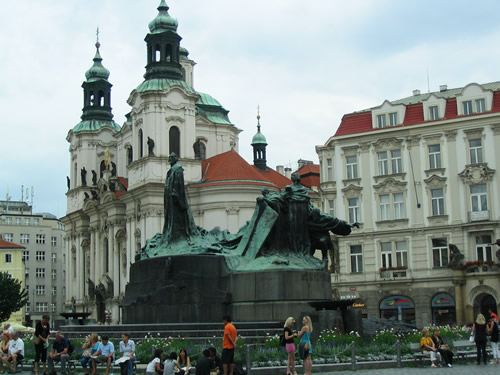
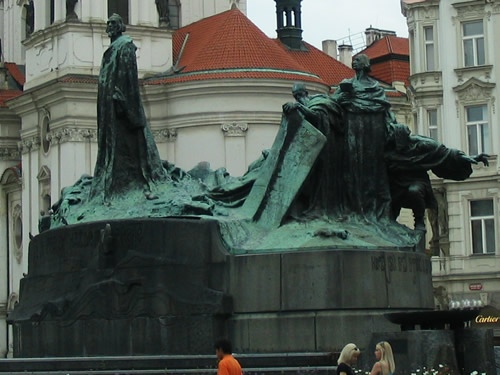
Much like St. John of Nepomuk, Jan Hus remains admired by Czechs for his integrity and courage. Old Town Square is home to his memorial:
Jan Hus memorial
And a closeup of the memorial:
Jan Hus memorial closeup

Monday
May
12th
2008
10:10 am

Holiday weekend in Olomouc

May 8 is a holiday in the Czech Republic (as it is in France and elsewhere) celebrating the Day of Liberation (the end of the 2nd World War). Since it fell on a Thursday, I persuaded (without great difficulty) my Friday classes to forego their lessons on the 9th, and visited Olomouc for a long weekend.

Why Olomouc?

Much as I like Prague, I’d really like to try living elsewhere in the Czech Republic. When I started asking around for alternate places to live, Olomouc was one of the names that cropped up most often. The second largest city in the Czech Republic, Brno, was usually dismissed as an unattractive industrial city that I would find boring. Olomouc, on the other hand, is a university town (of its population of 100,000, an estimated 20,000 are students). Olomouc’s main claim to fame these days is the Holy Trinity Column, which is a UNESCO World Heritage Site.
Holy Trinity Column, Olomouc
Historically, Olomouc was the capital of Moravia (although Brno now claims that distinction). It is also where Václav III, the last of the Přemyslid kings, was assasinated on his way to Poland to claim the Polish crown.

Sightseeing

Besides the Holy Trinity Column, Olomouc’s other main claim to fame is the Astrological Clock at City Hall:
Olomouc astrological clock
The clock itself is centuries old, although the mosaics surrounding it date from the Communist era. Olomouc has suffered the mosaics to remain because, despite the political implications, it really is quite stunning art work.

Olomouc is also noted for its fountains. There’s the Cæsar fountain:
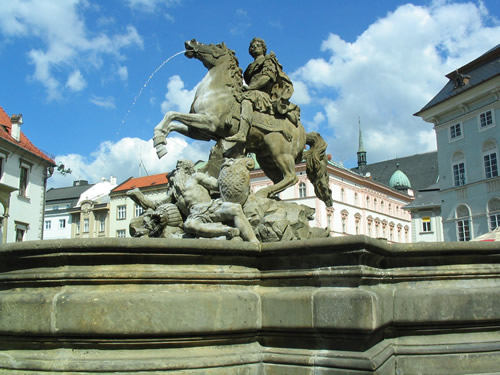
Olomouc Caesar fountain
It’s not as unlikely as it seems: the ancient tradition is that Olomouc was founded by Julius Caesar and indeed the name of the city is a corruption of "Julius’s Mont". And archaeological findings under what is now sv. Michael’s church in fact confirm a Roman presence.

The relatively recent Arion fountain is a great favorite, especially because of the turtle sculpture that adjoins it:
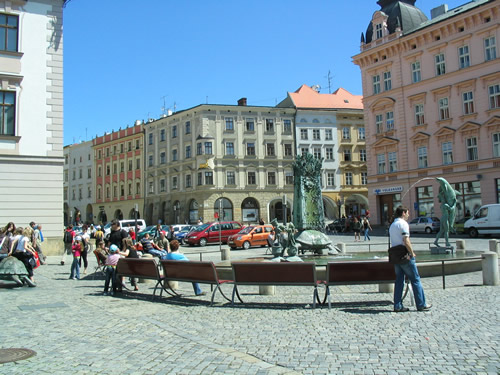
Olomouc Arion fountain

The Hercules fountain shares plaza space with the Holy Trinity Column:
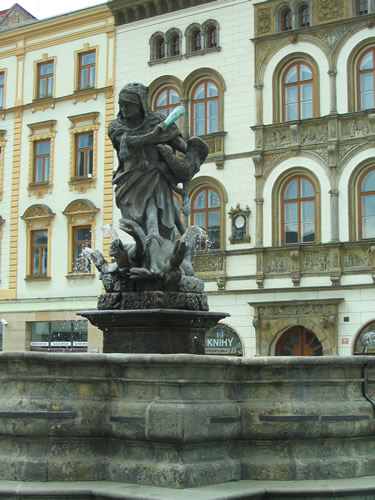
Olomouc Hercules fountain

Besides the Holy Trinity Column, there’s a Marian plague column, erected by plague survivors to celebrate their survival:
Olomouc plague column

There’s a little bit of the former Yugoslavia just outside the old city walls:
Yugoslav crypt in Olomouc
It was built to provide a resting space for Yugoslav soldiers killed during World War I, and, much like an embassy, the government gave the land to the government of Yugoslavia. The remains of the soldiers were subsequently repatriated sometime when Tito was on the outs with the Czechoslovak government, and the crypt fell into disrepair. The Olomouc city officials have recently persuaded one of the new countries that was formed by the dissolution of Yugoslavia to take responsibility for the (now empty) crypt, so with luck it will be spruced up soon.

The Church

The cathedral in Olomouc is sv. Václav:
St. Vaclav, Olomouc cathedral
The chapter house of the cathedral is where Václav III was assassinated:
Vaclav III plaque

I was in Olomouc over Pentecost, so I attended Mass at the cathedral on Sunday. Fittingly enough, they were celebrating Confirmation that weekend: about two dozen adults were confirmed. I noticed that those attending Mass were rather more formally dressed than I’ve been accustomed to in churches here, but maybe that was just because it was the cathedral or because of the Confirmations. The area immediately adjacent to the main altar is mostly kept locked if there isn’t a service, so there’s a chapel off the outer nave where the Sacrament is reserved. I also noticed that people stopped to genuflect in front of that chapel as they were entering and leaving the main altar area.

The Archdiocesan Museum adjoins the cathedral:
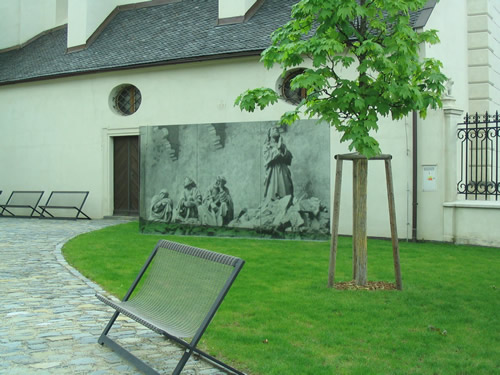
Grounds of the Archdiocesan Museum, Olomouc

Grounds of the Archdiocesan Museum, Olomouc
It’s a little surprising to me that, after 40 years of Communist suppression, the Church still has any treasures left. And actually, it does sometimes seem to me that the "jewels" in monstrances and the like are only cut glass (although that could be a security measure).

I also visited the Basilica of the Visitation on Holy Hill, a major (well, major for the Czech Republic) pilgrimage destination:
Basilica of the Visitation, Holy Hill, Olomouc
While the main entrance has been repainted, they haven’t (yet anyway) attended to the back or sides:

It put me in mind of an old Peanuts cartoon: Linus is showing off his newly shined shoes to Lucy, and as he turns to go, Lucy points out that he has only shined the fronts of his shoes, and not the backs. Linus replies that he cares what people think about him only when he’s arriving, not when he’s going.

St. John Sarkander

The closest thing that Olomouc has to a home grown saint is John Sarkander, who is venerated as a "martyr of the confessional". He was accused of treason by Protestant leaders and tortured partially due to his refusal to divulge what was said in confession. He died as a result of the torture, and the prison where he was held has since been converted into a chapel in his honor:
Chapel of St. John Sarkander
There’s also an altar with his relics in the cathedral. Although he died in 1620 and a cause for his canonization was started soon afterwards, he wasn’t beatified until 1860, and he was canonized only in 1995 by Pope John Paul II.

Dance

The Moravian Theater is the home for ballet and opera as well as drama. While I was there, the ballet was performing The Beatles and Queen, which sounded like an intriguing combination, especially for a ballet.

The music was presented (more or less) chronologically and the dance mimed the history of each group. It was very lively and went over well with the audience.

Haná Cuisine

I don’t really know enough about Czech cuisine to speak authoritatively on the differences between Bohemian and Moravian cooking, but I did notice a few little differences. Garlic soup, for example, is much heartier in Moravia; it includes ham and poached egg. And I was surprised by the "Chicken à la Duck": yes, the menu said it would be accompanied by sweet and sour cabbage, but I was expecting red cabbage, whereas this was white cabbage. And generally, white cabbage was more popular here than the red, whereas in Prague, it always seems to be red cabbage.

Olomouc’s Cafe 87 also has the only chocolate dessert that I’ve found worth eating in the Czech Republic: a bittersweet chocolate pie. The other chocolate desserts I’ve encountered in the Czech Republic have seemingly been based on milk chocolate and poor quality milk chocolate at that. Most baked goods also seem stale, or maybe Czechs just like their pastries on the dry side, but they’re not to my taste.
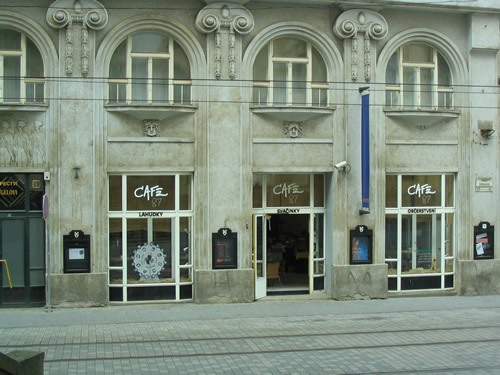
Cafe 87, Olomouc

I also tried (I think!) the famed Olomouc stinky cheese, but I was seriously disappointed. The aroma was very mild and not particularly unpleasant; the flavor was unremarkable; and the texture was very waxy. In fact, after the first bite, I took another look to make sure that I hadn’t overlooked a rind or wax covering that I was supposed to remove first! I tried asking the waitress if there had been a mistake, but unfortunately, neither her English nor my Czech was up to the task. So I don’t know if I was (inadvertently perhaps) cheated or if Olomouc stinky cheese really does not live up to its reputation.

The Joys of Czech Trains

I was seriously unprepared for the business of traveling by train over a holiday weekend. There are several trains a day between Prague and Olomouc, so I didn’t figure that, even for a holiday weekend, I would need to book in advance, and buying a ticket on Thursday was no problem. When I got on the train, though, not only was every seat taken, but the aisles and vestibules were also crowded. I was "lucky" enough to be able to claim a stairwell in the vestibule, but mostly I stood for the three-hour trip to Olomouc.

I wasn’t in a mood to repeat that for the return trip, so I made a seat reservation. The return train, though, had originated in Kraków and passed through Ostrava before getting to Olomouc so it was already standing room only. There was such a crush of people boarding I couldn’t stop to look for my seat until we were already underway, at which point, I found that I was at the opposite end of the car (fortunately I was at least in the right car!). Looking at the mass of people and luggage crowding the aisle, I was going to give up. However, the two very nice Czech ladies who were trying to get me oriented weren’t having any of that and handed me over to the conductor. The conductor went off with my ticket, leaving me no choice but to follow, stepping over my fellow passengers with many an apology.

When we located my seat it was, of course, occupied, and by a woman with a child sleeping in her lap. Fortunately, the man in the seat opposite chivalrously gave up his seat (and stood for 90 minutes to Pardubice) so that I wasn’t in the awkward position of having to oust a mother and child from my place.

Moral of the story: next time I travel on a summer weekend, I’m not only booking my seat in advance, I’m also going first class!

What Else?

I took way more pictures, but they don’t really fit into the narrative, so there’s a supplemental slideshow.

And it really is true that once you get outside of Prague, people don’t speak as much English. German is popular, which makes sense since the Czech Republic is bordered half-way around by German-speaking countries, and in Olomouc, Polish is reasonably popular, which again makes sense. But not a lot of English.

Sunday
May
4th
2008
1:59 am

Pilgrimage to Svata Dobrotiva

While the Augustinians have been at sv. Tomáš since the end of 13th century, svatá Dobrotivá, near Zaječov, was the first Augustinian foundation in the Czech lands. The church and monastery are named for Saint Benigna (and how you get “Dobrotivá” from “Benigna” is a mystery to me), whose relics are kept there. sv. Tomáš holds an annual Marian Pilgrimage there the Saturday of the 6th week of Easter. This year was the 11th such pilgrimage since the practice was resumed.

The Story behind the Pilgrimage

Quoting from the program:
“According with the oldest legend, in the year 1262 Oldrich of Valdek, who was devoted to the Blessed Mother, one night heard in his room a certain whispering, or slight movement, and while still in bed listened to a voice that said:

“Oldřich, this is the will of both my Son and myself that in this place in which you see me standing you would as soon as possible build in his honor and in my name a church and a monastery for my servants and you will receive from my Son whom you willingly serve an ample reward…”

“The tradition said that everybody who went to the sactuary and left their problems at the feet of Mary, she would take them upon herself. Let us go to Mary. Do not forget our petitions. O holy mother.”

The Pilgrimage

I’m told that there were about 85 of us; I’m guessing that roughly 2/3 were Czech and (most of) the rest were English-speakers. (There was one girl who was pointed out to me as being from the Spanish-speaking community, but for the most part, the Spanish-speaking community was not represented. I don’t know why not.) We left Prague at about 8:30 and arrived at Olešna, the starting point for our walk, at about 9:30:

The buses were available to transport those who felt themselves unable to walk the 2 km or so, but the rest of the group set off for Zaječov. The walk took us through some lovely, open countryside:

As we walked through some of the villages along the way, the residents turned out to watch us and even to take pictures. We apparently introduced a marked note of novelty into their day!

There was a little chapel at about the midpoint, where we stopped for the Litany of Loreto:

The monastery complex came into sight a little bit past the chapel:

The cemetery en route is where the priests, parishioners, and benefactors of sv. Tomáš and the Augustinians are buried, and so we paused to pray for their souls:

There is what I think is a war memorial along the side of the monastery as we approached:

And a closer view:

When we reached the church, we processed around the altar to see the place where Our Lady is said to have appeared to Oldřich of Valdek and then sang the "Salve Regina"

The local parishioners turned out to welcome us. While we had been instructed to pack lunches, this turned out to be completely unnecessary: our local hosts were ready for us. Tray upon tray of open faced sandwiches, cookies, seriously addictive baby tarts and more were waiting for us in the refectory. They were extremely gracious in their hospitality, and it seems that this pilgrimage is a high point in the parish’s year.

After lunch, we had free time for exploring the monastery and for the Sacrament of Reconciliation before Mass at 2 PM. We headed back to Prague at about 4 PM.

The Augustinians had been turned out of sv. Dobrotivá by the Communists in 1950, and the monastery subsequently used as an internment camp, refugee asylum and finally a sports museum before being returned in 1998. The Augustinians have been working on its restoration since then, and the church has been largely restored:

Restoration of the cloister, on the other hand, remains an ongoing project and clearly has a long way to go:

(Once a month, on the third Saturday, sv. Tomáš sponsors a "work party" to go down to sv. Dobrotivá to help with the restoration.)

The parish website had a slideshow of last year’s pilgrimage, but apparently it’s no longer available.

Looking for more?

Add to Technorati Favorites


follow webgeekstress at http://twitter.com
Random books from my "Currently Reading" stack...