Posts Tagged ‘Czech Republic’

Saturday
March
15th
2008
10:37 am

Obcan Havel (Citizen Havel)

Občan Havel is a documentary that follows Václav Havel during his terms as first President of the Czech Republic (1993-2003) (not to be confused with his term as tenth and last President of Czechoslovakia from 1989 to 1992). It came out at about the same time as the latest presidential election that re-elected his successor, Václav Klaus. The filmmakers followed Havel for the 10 years of his presidency, and reportedly filmed 45 hours of images and recorded 90 hours of sound material.

It was shown (at least in some theaters) with English subtitles, so I went to see it as part of my ongoing efforts to understand my current country of residence. I was worried that it might be a bit obscure, and I did in fact spend a fair amount of time wondering, “Who are these people”? However, the movie was more focused on examining the man than on his politics, and so I was pretty well able to make sense of it. It also gave me plenty of fodder for conversations with my students, e.g., “What was Charter 77?” ” What do you think of Dagmar Havlová?” (Apparently Havel’s second wife is not universally beloved, unlike his first wife.)

I kept trying to picture a similar documentary about President Bush (or indeed, to be fair, any other American president), and couldn’t. Any such attempt would be stage-managed to a fare-thee-well. Havel, though, appears to be largely indifferent to the presence of the cameras, although we occasionally see him being friendly with the crew (and his staff is not always similarly unaware of the cameras). And, while it’s certainly a partisan portrayal, we do sometimes see Havel being superficial and/or petty, fretting over his dandruff or sniping at Václav Klaus. Mostly though, it’s simply a thoroughly human portrait of courageous and principled man.

Last fall, I visited the French Embassy, which was open to the public for the day as part of European Heritage Days. When I got to the main dining room, the little brochure told of François Mitterand’s 1988 visit to still-Communist Czechoslovakia and Mitterand’s insistence, as a condition of his visit, that he be allowed to meet some of the dissidents. The Czech government complied, and Havel was among those invited to have breakfast with Mitterand. Reportedly, he showed up with his toothbrush, just in case he ended the visit by being arrested (again).

I don’t suppose that the movie is likely to play in the U.S., or even to come out on Netflix, but it would be worth checking out if it does become available. There’s another review here: prague.tv/articles/cinema/obcan-havel.

Tuesday
March
11th
2008
3:07 pm

Dutiful Pedestrians, Revisited

I wrote about Czech pedestrians and their willingness to wait on traffic lights several months ago. This past weekend, I particularly noticed the phenomenon again. I was waiting at a traffic light, and on the other side of the street, there were a couple of Prague police officers and another couple. The couple, after checking to make sure that there was no oncoming traffic, started across the street. One of the police officers started calling after them, but they ignored her until they had crossed the street. Only then did they look behind them to acknowledge the officer. I couldn’t understand what the officer said, but from her gestures and her tone, I would guess that it was something along the lines of, "Get back here and wait for the light". The couple shrugged and went on, while the pair of officers waited for the light. I turned around to peek after crossing the street, but no, the officers did not set off in hot pursuit of the jaywalking pair.

I mentioned this to the students in one of my classes and found that the penalties for jaywalking, in Prague at least, are quite stiff. In fact, if you’re the victim of an accident that occurs when you are crossing against the light, you will leave the hospital only to be hit with a citation and a hefty fine. That "The pedestrian has the right of way" is apparently an entirely foreign concept here.

Saturday
January
26th
2008
2:47 pm

The Butter Museum at Máslovice

Last month, one of my students told me, in response to my usual "So, what did you do this weekend?", that she and her boyfriend had visited the Butter Museum at Máslovice.

"Wait: did you say butter?"

"Yes, the Butter Museum."

"Butter? The yellow stuff they make with milk and you spread it on your bread? Butter?"

"Yes, the Butter Museum. They have a Betlem (Nativity scene) made out of butter."

"So wait, now where is this? Máslovice? Where’s that?"

"I’ll bring you a map."

And the next class, she did indeed bring me

  • a map showing where to find the correct bus stop at the Kobylisy metro station;
  • a map of Máslovice, showing where the museum is in relation to the bus stop;
  • a bus schedule; and
  • notes about when the museum is open (Saturday and Sunday, from 10 to 12 and from 1 to 4) and how long the Betlem would be there (from the beginning of December through the end of January).

Máslovice is north of Prague, and there’s a certain logic to a Butter Museum being housed there, as the Czech word for butter is máslo. The bus ride from the Kobylisy metro station takes about 30 minutes. The countryside surrounding Prague becomes rural amazingly quickly, and the map of Máslovice was really not necessary, as there’s hardly anything there and the museum, small as it is, was hard to miss.

The "curator" is a very nice young man named David, who seemed delighted to have a native English speaker to practice his (very good) English on. He willingly showed me through the museum, explaining the exhibits, leaving my side only to collect the admission fee from other visitors and then returning to continue our conversation. There is in fact no butter connection to Máslovice: the town was named after a person named Máslovics. I asked about the Betlem: it was carved by a 24-year old actress living in Prague, but this was to be its last weekend. It was beginning to stink, David candidly observed. Only the third of the three rooms of the museum is devoted to butter, but it is full of butter making implements and paraphernalia, including butter molds, a collection of butter wrappers from around the world, and more kinds of churns than I had ever realized existed. I was particularly taken with one in the form of a child’s rocking horse. The container for the milk forms the body of the horse, so the child’s rocking can churn the butter. I thought that was particularly ingenious.

The second of the three rooms of the museum is actually dedicated to chocolate. It turns out that the person who is listed in the Guinness Book of World Records as having the largest number of chocolate wrappers is a Czech (though not an inhabitant of Máslovice), and it’s a rotating portion of his collection that is on display.

The first of the three rooms is just the gift shop/reception area. If you’re in the Prague area looking for gifts depicting cows, this is where you want to come.

The weekend of April 12-13, there’s to be a Butter Festival at which visitors will be able to participate in making their own butter. I’m thinking that it might be fun to go back for that.

Monday
December
24th
2007
7:28 am

Clubbing carp for Christmas

The traditional Christmas Eve dinner in the Czech Republic is carp, breaded and deep fried, served with potato salad. In anticipation of this dinner, fish mongers with tubs of live carp appear on street corners and plazas a few days before Christmas Eve, and people line up to buy their carp. I’m told that some Czechs take the carp home live and kill the fish themselves. Most people, though, let the fish mongers do the dirty deed. And so the fish sellers scoop a carp out of the tub and give it a few sharp whacks on the head with a mallet before beheading it. (People take the fish heads, too, since fish soup is also a traditional accompaniment to the dinner.)

I suppose that if one isn’t vegetarian, it’s just as well to be reminded of exactly what is entailed in the eating of fish or poultry or meat.

And every time I saw this transaction taking place, I was reminded of Tom Lehrer’s Poisoning Pigeons in the Park:
[youtube]http://www.youtube.com/watch?v=yhuMLpdnOjY[/youtube]
Indeed, I’m sure that if Lehrer were Czech, he might have come up with something along the lines of Clubbing Carp for Christmas.

You can also buy carp filets at the supermarket, and indeed, I even saw some frozen breaded carp all ready for cooking, but very few of the Czechs with whom I’ve spoken admit to going that route.

Sunday
November
4th
2007
4:23 am

Birthday weekend in Mariánské Lázne

For my birthday, I decided to treat myself to a weekend out of town. I had originally thought of Karlovy Vary, but was told that "Ah, there’s nothing but rich Russians there!". Mariánské Lázně (which may be better known to some as "Marienbad"), on the other hand, was described as still being more Czech. Well, I’m in no position to compare, but there was certainly no shortage of rich Russians at Mariánské Lázně!

I stayed at the Nové Lázně, which is arguably the grandest of the spa hotels:

I had a very comfortable room overlooking the park:


That’s the Church of the Assumption in the upper right; here’s a closer view of this octagonal church:

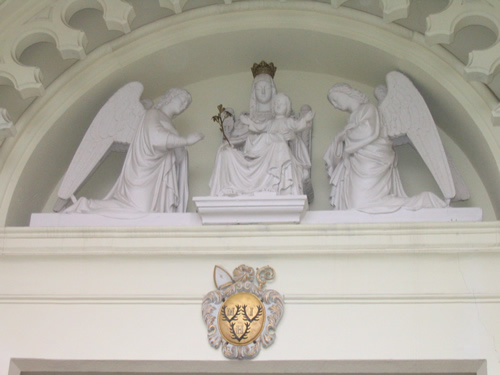
And the archway over the door:
The assurances of the travel agency through which I arranged my stay notwithstanding, English was in short supply: there was German and Russian in abundance, but very little English. I spent most of my weekend communicating with the staff in mime, my highly limited Czech, and guessing at German!

When I showed up at the dining room for dinner, there was a brief flurry as the hostess, who spoke very little English, summoned a waiter to figure out where to seat me. The hostess and the waiter had a brief discussion, in which the only Czech word that I recognized was "Angličanka" (Englishwoman), after which I was led to a table which I shared with a very nice woman from Britain. She was coming up on the end of a two-week stay at Mariánské Lázně, and professed herself to be delighted to be able to have someone with whom she could speak English.

They take the whole "health resort" thing very seriously, and indeed, they don’t seem all that keen on catering to weekend dilettantes. I had to have an interview with a nurse before I could schedule any treatments, and supplemental services were either fully booked already or were simply unavailable over a weekend. Fortunately, my package included two treatments a day, and those were provided: I had two each of the partial medical massage, dry CO2 bath and mineral bath.

The dry CO2 bath was the most unusual experience. Here is the brochure description:

This is another signature treatment of the spa resort of Marienbad where the gas – Marie’s gas – that bubbles naturally out of the ground is used for the treatment. This gas is of volcanic origin and contains 99.7% CO2. In our other resorts normal commercial CO2 gas (the same as in the food industry) is used. During the treatment you lie fully clothed, comfortably on a bed enclosed in a large plastic bag that is sealed just under the arms. The gas is then pumped into the bag, which slowly inflates, where it is absorbed through the clothes and skin into the body where it slows down heart activity and reduces blood pressure. The gas also improves blood circulation and kidney activity and has an anti-inflammatory effect. The gas is also known to stimulate the production of the sexual hormones, testosterone and estradiol, which is why it is successful for the improvement of sexual functions and to relieve menopausal symptoms in women. Time: 30 minutes, Doctor’s prescription required: No, Benefits: Therapeutic, Well Being.

The mineral bath is pretty well self-explanatory, but here’s the brochure description for that one:

This is a signature treatment, exclusively provided in the spa resort of Marienbad using the natural local mineral waters and natural CO2 gas that naturally seeps out from the ground. The water is heated to a temperature of between 28-34° C in an individual bathtub, into which is pumped the natural CO2 gas that fizzes onto the skin, producing a relaxing, tickling sensation. The carbon dioxide is absorbed through the skin into the body, where slows down the heart activity and reduces the blood pressure. Several treatments will result in improved blood circulation, heart and kidney activity as well as reduced stress and anxiety. The benefits and procedures are similar to the carbon dioxide bath treatment, however the advantage here is that all the properties used are both local and natural. Time: 20 minutes + dry wrap (15 minutes), Doctors prescription required: no, Benefits: Therapeutic, Well Being

The thing that surprised me most about the mineral bath was that the water was no more than tepid! One of the ubiquitous rich Russians I chatted with one evening told me that, to get a hot mineral bath, I should go to a Hungarian spa!

In keeping with the whole "health resort" routine, life in Mariánské Lázně is very tranquil, and there’s not a lot to do. The main tourist attraction (aside from the waters and spa treatments) is the Singing Fountain:


Every other hour during the season, the fountain "performs" to a soundtrack of such pieces as Petr Hapka’s Music for the Fountain or Chorus of Hebrew Slaves from Verdi’s Nabucco or Dvořák’s Carnival, Op. 92. As my dinner companion pointed out, it would be more accurate to describe it as the "Dancing Fountain", rather than the "Singing Fountain". According to some of the flyers and brochures I saw around town, it looks as though the singing season is supposed to end on October 30. I guess they knew I was coming, though, because the Gala Closing actually took place on my birthday!

The fountain is in the Colonnade park:

The park also has a statue of Abbot Reitenberger of Tepla Monastery:

The abbot is credited with having established the spa town.

And perhaps it’s to cater to those rich Russians that this Church of St. Vladimir was built:

Looking for more?

Add to Technorati Favorites


follow webgeekstress at http://twitter.com
Random books from my "Currently Reading" stack...