Archive for the ‘Life in the Czech Republic’ Category

Saturday
March
22nd
2008
8:37 am

Easter Markets and Pomlázky

Easter Markets

I was curious to know if Easter Markets were substantially different from Advent Markets. There are really only trivial differences. They’re smaller, for one; in fact, Náměstí Míru didn’t even have one. Most of the stalls sell the same touristy junk that they sold before Christmas, and the food and drink are largely the same. In particular, the trdelník stalls are hugely popular:
Trdelnik
It’s fun to watch trdelník being made. They start with sweet yeasted bread dough. The baker rolls a chunk of dough into a long snake, which is then wrapped around a stainless steel cylinder. After two or three snakes have been wrapped, the cylinder serves as a rolling pin to flatten the dough while it’s rolled in a mixture of coarse, spiced sugar and almonds. The dough-covered cylinder is then set in a rack that spins the cylinder over an open fire so that the dough bakes and the sugar caramelizes. When the trdelník is all nice and toasty brown, it comes off the fire and is rolled once more in the sugar and almond mixture. Needless to say, they’re best hot off the fire.

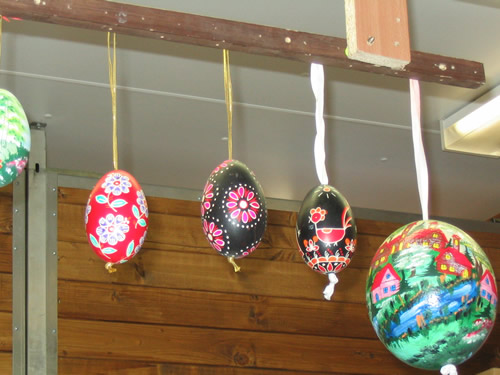
The main place where the Easter markets differ from the Advent markets is that the Christmas decorations are (mostly) replaced by decorated eggs:
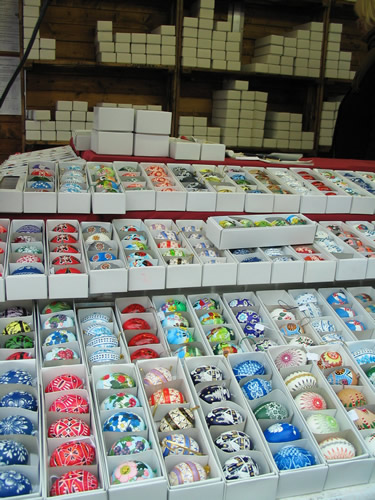
Easter eggs

Easter eggs

Easter Market at Anděl

The Easter Market at Anděl is a small one: just a couple of dozen stalls. What I like about it, though, is that it has a pony ride:
Pony ride at Andel
It also has a couple of other rides for children. There’s a choo-choo train:
Children's train ride at Andel
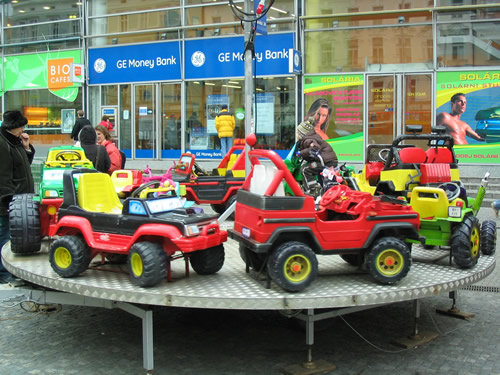
And there’s a car ride:
Children's car ride at Andel

Easter Market at Staroměstské Náměstí

The big Easter market, at Staroměstské Náměstí (Old Town Square), on the other hand, has a much larger collection of stalls. In addition, there’s a sort of little petting zoo:
Petting Zoo
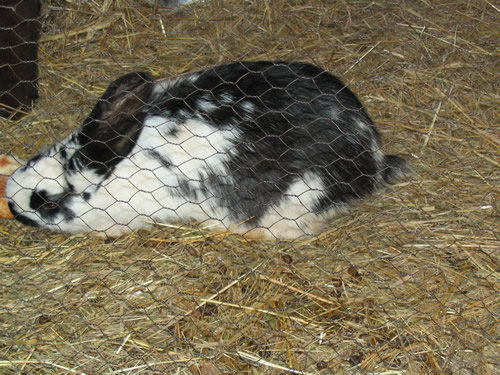
The Easter Rabbit?
Easter Rabbit?
There’s also a blacksmith at work:
Blacksmith
Instead of a Christmas tree, there’s an Easter egg:
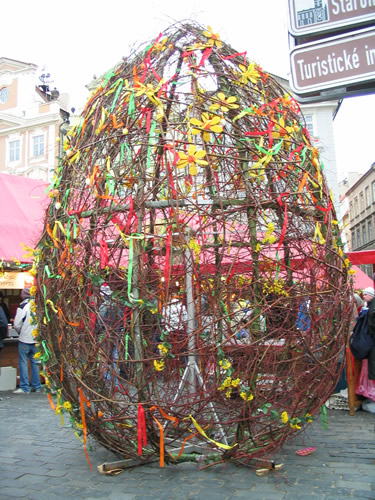
Easter egg
There’s also an Easter tree (there, behind the Jan Hus memorial):
Easter tree

Florists and Pomlázky

A few weeks ago, I started seeing these bundles of twigs trimmed with multi-colored ribbons at florists’ stands:
Pomlazka
I asked one of my students about them, and he became a little flustered and claimed (rather disingenuously) that they’re just a traditional Spring decoration. It took me a while longer to find out that they are supposed to be used on Easter Monday, when the men whip the women to keep them beautiful and/or fertile. Not surprisingly, the men in my classes all disclaim any participation in this pagan ritual: "It’s practiced only in some of the smaller villages these days", they tell me. And according to this article from the Prague Post, they may be correct. However, several of my women students have admitted that their husbands or boyfriends have brought home their pomlázky, which will be used for the traditional purpose. (I’m staying out of this: they’re consenting adults and I’ve no reason to believe that any of these women is in an abusive relationship.)

And, it turns out that pussy willows aren’t just for Palm Sunday:
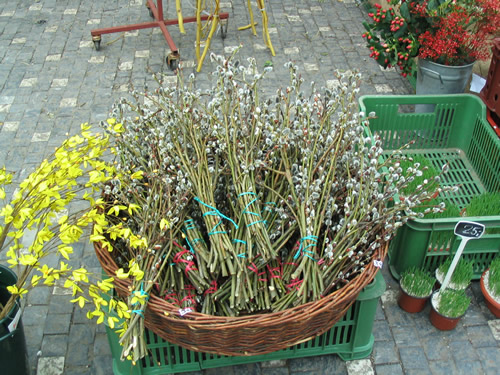
Pussy willows

Tuesday
March
18th
2008
3:30 pm

The camera returns…

So, I finally called Canon again and, this time, I was successful in reaching someone who spoke English. I explained the problem and was referred to an authorized Canon repair shop, which oh-so-conveniently is just a few blocks from my flat. I went in, handed over the camera with the speculation that it was a problem with the CCD. The technician looked at it, agreed, confirmed that this was a problem that Canon had agreed to fix for free, and told me that my camera would be ready within 14 days. He also told me how to check for status on their website. And so it is that, barely 10 days later, I have my camera back again: yippee!

Sunday
March
16th
2008
1:13 pm

Liturgical Anthropology: Palm Pussy Willow Sunday

Preliminary Note About Sv. Tomáš

I should preface this by explaining a little bit about Sv. Tomáš (St. Thomas’). The Church and monastery of Sv. Tomáš was established in 1285 by King Vaclav II, and we still pray for him every Sunday. It’s in Malá Strana and is staffed by Augustinians. Apparently the neighboring churches of Sv. Josef and Panny Marie Vítězné (Our Lady Victorious; home of the statue of the Infant of Prague) are also part of the parish, although I don’t understand how that works.

Besides being the official home of the English-speaking Catholic community in Prague and home to a Czech-speaking community, there is also a Spanish-speaking community that makes its home here. Mostly this isn’t much of an issue. On Sundays, there’s a Czech Mass at 9:30; the English Mass is at 11:00; while the Spanish Mass is at 12:30. On Christmas, it got a little more complicated, and the "Midnight Mass" in English actually took place at 6:00 PM, which I didn’t realize until after the fact and so it was that I attended the Czech Midnight Mass.

Palm Sunday

For Palm Sunday, then, the three communities that make up Sv. Tomáš had a joint celebration that started at 9:30 at Panny Marie Vítězné. When I arrived at the church, there was a donkey on the lawn in front of the church, placidly enduring the curious tourists with their cameras.

At the door of the church, attendants were handing out not palms, but pussy willow branches. Which makes more sense than importing palms, although the mental picture of throngs lining the road into Jerusalem with pussy willows and waving them as they sing their "Hosanas" makes me smile. (Last year, at Sacré Cœur, we didn’t receive palms either; instead, we got green branches of some kind – laurel, maybe?)

When the service started, we had opening prayer in English, Czech, and Spanish; the Procession Gospel was proclaimed each of the three languages; and the branches were blessed three times: once in each language. One of the boys of the parish was there, in a red hooded cloak; he was the "stand-in" for Jesus and was mounted on the donkey. We then wended our way in procession through some back streets of Malá Strana to Sv. Tomáš. Once there, I saw the main doors of the Church thrown wide open for the first time to allow our mounted "Christ" to go right up to the altar, where he dismounted. (I didn’t notice, but I’m guessing that the donkey was led into the cloister gardens.)

Once the Mass proper started, we had a quadrilingual (Czech, Spanish, English, and Latin) liturgy, with the languages trading off rather than prayers and readings being repeated. From a pastoral point of view, of course, it makes perfect sense. However, I was disappointed by the way in which it was implemented. Maybe I’m just spoiled, but the Oakland diocese certainly knows a lot more about how to put on a multi-lingual liturgy! As it was, it was impossible to fully participate in, and difficult even to follow, the non-English parts of the liturgy. I must say, though, that the Czech choir is absolutely exquisite!

The language issue aside, the Mass was unremarkable, except that Communion was given by intinction (i.e., the minister dipped the Host in the Chalice before placing the Host on the communicant’s tongue). The only other time I’ve seen that done was at Sacré Cœur last year, at the Mass of the Lord’s Supper. But at Sacré Cœur, they usually don’t offer Communion under both species, while at Sv. Tomáš, they always do, so this departure from the norm seemed rather odd to me.

Saturday
March
15th
2008
3:23 pm

Night at the Opera

My Friday night visit to hear Martinů’s Řecké pašije (Greek Passion) marked my first visit to any serious theater since leaving California. The opera is based on Nikos Kazantzakis’s novel Christ Recrucified.

Brief synopsis:

The preparations for the annual Passion play in the Greek village of Lycovrissi are interrupted by the arrival of refugees whose village has been destroyed by a Turkish attack. The refugees are defended by the shepherd Manolios, who had been chosen for the role of Jesus Christ. Other villagers, particularly the Passion play’s Mary Magdalene (who in real life is also the village prostitute), St. James, St. Peter, and St. John, similarly attempt to help the refugees, but the priest, Grigoris, leads resistance to their presence. Finally, in an argument, the villager Panait, the Passion’s Judas, kills Manolios, and the refugees leave the village in search of a new home.

This was my first visit to the National Theater (Národní Divadlo), since it’s not open to visitors except for performances. It’s a really lovely theater (alas that I’m still camera-less).

The performance itself was wonderfully sung and beautifully staged, and I very much enjoyed the evening out.

Saturday
March
15th
2008
10:37 am

Obcan Havel (Citizen Havel)

Občan Havel is a documentary that follows Václav Havel during his terms as first President of the Czech Republic (1993-2003) (not to be confused with his term as tenth and last President of Czechoslovakia from 1989 to 1992). It came out at about the same time as the latest presidential election that re-elected his successor, Václav Klaus. The filmmakers followed Havel for the 10 years of his presidency, and reportedly filmed 45 hours of images and recorded 90 hours of sound material.

It was shown (at least in some theaters) with English subtitles, so I went to see it as part of my ongoing efforts to understand my current country of residence. I was worried that it might be a bit obscure, and I did in fact spend a fair amount of time wondering, “Who are these people”? However, the movie was more focused on examining the man than on his politics, and so I was pretty well able to make sense of it. It also gave me plenty of fodder for conversations with my students, e.g., “What was Charter 77?” ” What do you think of Dagmar Havlová?” (Apparently Havel’s second wife is not universally beloved, unlike his first wife.)

I kept trying to picture a similar documentary about President Bush (or indeed, to be fair, any other American president), and couldn’t. Any such attempt would be stage-managed to a fare-thee-well. Havel, though, appears to be largely indifferent to the presence of the cameras, although we occasionally see him being friendly with the crew (and his staff is not always similarly unaware of the cameras). And, while it’s certainly a partisan portrayal, we do sometimes see Havel being superficial and/or petty, fretting over his dandruff or sniping at Václav Klaus. Mostly though, it’s simply a thoroughly human portrait of courageous and principled man.

Last fall, I visited the French Embassy, which was open to the public for the day as part of European Heritage Days. When I got to the main dining room, the little brochure told of François Mitterand’s 1988 visit to still-Communist Czechoslovakia and Mitterand’s insistence, as a condition of his visit, that he be allowed to meet some of the dissidents. The Czech government complied, and Havel was among those invited to have breakfast with Mitterand. Reportedly, he showed up with his toothbrush, just in case he ended the visit by being arrested (again).

I don’t suppose that the movie is likely to play in the U.S., or even to come out on Netflix, but it would be worth checking out if it does become available. There’s another review here: prague.tv/articles/cinema/obcan-havel.

You are currently browsing the archives for the Life in the Czech Republic category.

Looking for more?

Add to Technorati Favorites


follow webgeekstress at http://twitter.com
Random books from my "Currently Reading" stack...