Since I cited Tom Lehrer in my post about clubbing carp for Christmas, I thought it was appropriate to highlight Google’s tribute, on the occasion of his 80th birthday.
(Belated) Happy Birthday!
 Yurtdışında Yaşam
I'm finally satisfying a long-held dream of living abroad. I started with six months in France followed by two and half years in the Czech Republic. Now, I'm giving Turkey a try.
Since I cited Tom Lehrer in my post about clubbing carp for Christmas, I thought it was appropriate to highlight Google’s tribute, on the occasion of his 80th birthday.
(Belated) Happy Birthday!
I haven’t been out of town for a couple of months, not since my January trip to the Butter Museum at Máslovice. So I pulled out my little guidebook and started paging through the section on day trips, where I ran across a description of Mělník. So I hopped on the bus to have a look.
The castle (of course there’s a castle: this is a Czech town) is beautifully situated, on a hill overlooking the confluence of the Vltava and Labe rivers:
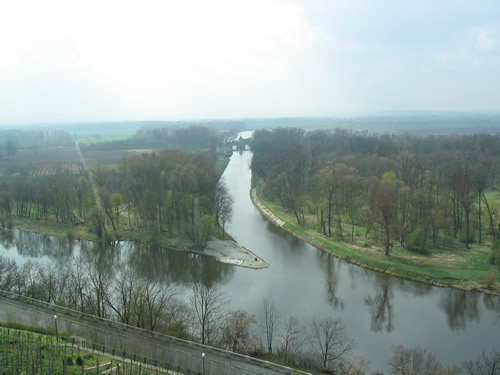
This view is said to be the inspiration for Smetana’s Ma Vlast ("My Country"). The castle was confiscated from the Lobkowicz family by the communists, but has since been returned to them.
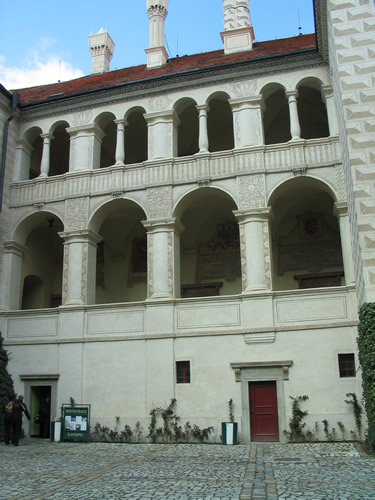
From the castle courtyard; in the lower left is the entrance to the restaurant:
And the opposite side of the courtyard:
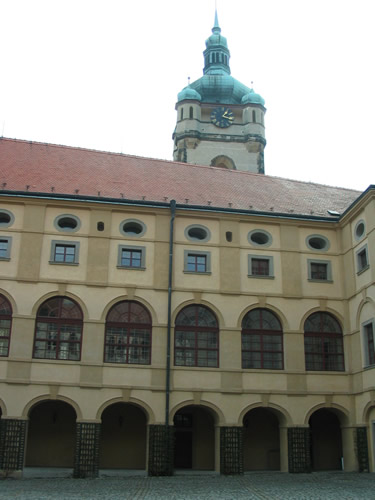
That’s the spire of the Cathedral of Sts. Peter and Paul in the background.
The castle has been well-restored and the tour was interesting. As an aside, I’ll point out that, by and large, it’s the castles that have been returned to private hands that have been better restored and that have better tours. The ones operated by the government have largely been gracelessly restored and the tours are more boring.
The Cathedral of Sts. Peter and Paul has an ossuary that a Czech professor designed with a group of his students back in 1914. Once you’ve seen the ossuary at Sedlec, though, this one is a snoozer!
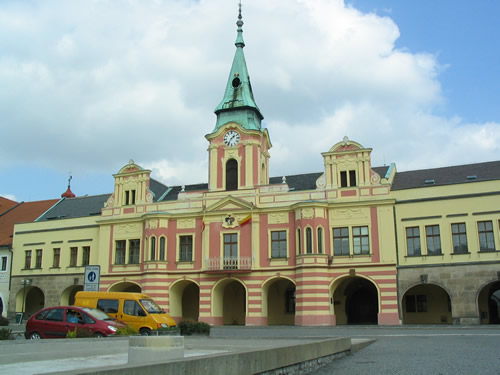
There’s really not much else to see in Mělník. The City Hall on the main square is attractive, but not worth a trip:
On my way back to the bus stop, I happened to pass by a cemetery, and decided to take a peek:
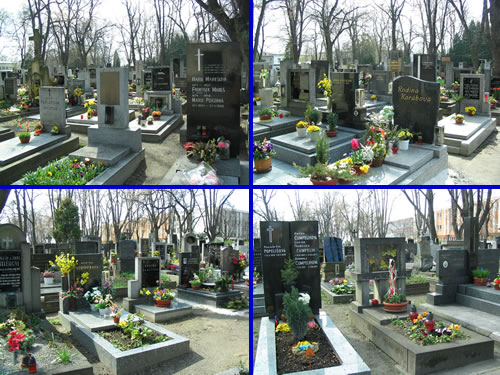
I was really surprised, and touched, that it seemed that all of the graves were decorated with potted flowers. It was only when I noticed the pomlázka decorating one of the arrangements that I realized that this must be an Easter-specific tradition. Even so, it was impressive that each grave apparently had someone still caring for it.
So, spring is putting in some tentative appearances: the snow seems to have stopped, the cherry blossoms are in bloom, and people are venturing into the parks. I paid my first visit to Stromovka ("place of trees") Park this weekend.
The weeping willows are drooping picturesquely:

The afore-mentioned cherry blossoms are on display:

And everything is beautifully green:
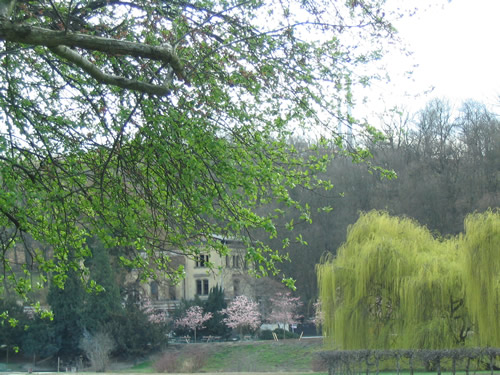
(And no, I’m not sure what these buildings are.)
There’s also a planetarium in Stromovka, and I was thinking about visiting, as I dearly love a planetarium show. But the commentary would all be in Czech, so I decided against it. For now, anyway.
While waiting for the tram home, I noticed these paintings on the walls of adjoining buildings:
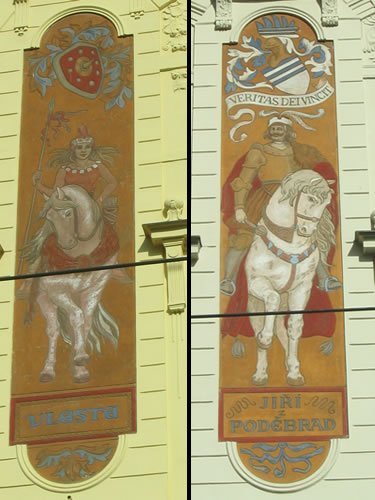
I’d kind of heard of Jiří z Poděbrad, though I couldn’t off-hand tell you much more than that he was a King of Bohemia and that the next metro stop from Náměstí Míru is named for him. Vlasta, on the other hand, was completely new to me, and it took me a bit of Googling to find out who she was. Turns out that she is said to have been the favorite handmaid of the mythical Libuše, the prophetess who founded Prague. Libuše had been careful to protect the rights of women, and when she died, those rights were endangered. So Vlasta rallied the other women, and launched the Maidens’ War. There is, alas, no happy ending. Which is probably why it’s so hard to find out who she was.
I was half expecting quadrilingual liturgy for Triduum, much as we had for Palm Sunday, but in fact, for Holy Thursday and Good Friday, we had strictly English language liturgies. The Spanish speaking community had their liturgies in St. Barbara’s Chapel, just off the cloister garden, and I have no idea where the Czech community ended up. And for Easter Sunday, we had our usual schedule of three Masses, one for each community. For Easter Vigil, though, we did indeed have a Czech-Spanish-English-Latin mix, similar to that of Palm Sunday.
The liturgies on Holy Thursday and Good Friday were largely unremarkable. I was glad to see, though, during the ceremony of the washing of feet that Sv. Tomáš does not follow the practice of having only men come forward. Instead there was a mix of men and women, and even one child. There were, however, only 6 washees; I’m not sure why we didn’t have the full complement of 12.
The only place where the Good Friday service departed from the norm was in the timing: it took place at 6:30 PM rather than mid-day. I think this was probably a concession to the fact that in this largely atheistic city, it would be difficult for working people to attend a mid-day service. I was disappointed, though, as I had wanted to attend a performance of Dvořák’s Stabat Mater that had been scheduled for that evening at Národní Divadlo.
As at Palm Sunday, the quadrilingual nature of the service made it difficult to follow along, and I’m seriously disappointed with the way in which Sv. Tomáš handles this. I’m thinking that, next year, I’m going to give serious consideration to making a Triduum retreat in an English-speaking country.
It was gratifying to see, though, the number of people being received for Baptism: there were eight Czech neophytes and two from the English-speaking community. And that’s the only thing that would hold me back from going on a retreat instead: a Vigil without Baptism would seem rather hollow.
At the conclusion of the Vigil service, we had a "Theophoric Procession", which was described to us as a Czech tradition. (I had to look "theophoric" up myself: it’s from the Greek meaning "bearing a deity".) The presiding priests and the altar servers went in procession to St. Dorothy’s Chapel, which had been used as the Reservation Chapel following Holy Thursday’s Transfer of the Sacrament. They knocked at the door of the Chapel, which opened to reveal a statue of the resurrected Jesus. The statue was then carried in procession, followed by the community, out of the church, around the cloister gardens, and back into the church, where the statue was left at the altar, by the ambo.
For the Easter Sunday Mass, we again had not only a Theophoric Procession, but an "Encuentro" (Spanish for "encounter"). This is a tradition borrowed, obviously enough, from the Spanish. In this particular version, while the men of the community were invited to process behind the statue of the resurrected Christ, the women were invited (though not obliged – Father William was very careful about that!) to follow a black-draped statue of Our Lady out through a different door of the church and around the cloister gardens, in the opposite direction traced by the Theophoric Procession. Our two groups met in front of St. Barbara’s Chapel, and the statue of Our Lady was unveiled, representing the first post-resurrection meeting between Jesus and His mother. We then completed our circuit of the gardens and returned to the church, where the statue of the resurrected Christ was returned to its place near the ambo while the statue of Our Lady went to the opposite side of the altar.
I haven’t yet mastered the art of taking photos at night. At the very least, I think I need a tripod, but it may just be that my trusty little Canon isn’t up to the task. I keep trying, though, and I’m actually quite enchanted with this shot of Týnský Chram (Tyn Cathedral):
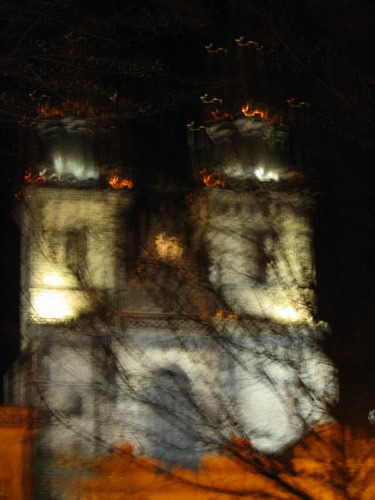
Très surreal, n’est-ce pas?
You are currently browsing the archives for the Life in the Czech Republic category.
