Archive for the ‘Life in the Czech Republic’ Category

Sunday
May
4th
2008
1:59 am

Pilgrimage to Svata Dobrotiva

While the Augustinians have been at sv. Tomáš since the end of 13th century, svatá Dobrotivá, near Zaječov, was the first Augustinian foundation in the Czech lands. The church and monastery are named for Saint Benigna (and how you get “Dobrotivá” from “Benigna” is a mystery to me), whose relics are kept there. sv. Tomáš holds an annual Marian Pilgrimage there the Saturday of the 6th week of Easter. This year was the 11th such pilgrimage since the practice was resumed.

The Story behind the Pilgrimage

Quoting from the program:
“According with the oldest legend, in the year 1262 Oldrich of Valdek, who was devoted to the Blessed Mother, one night heard in his room a certain whispering, or slight movement, and while still in bed listened to a voice that said:

“Oldřich, this is the will of both my Son and myself that in this place in which you see me standing you would as soon as possible build in his honor and in my name a church and a monastery for my servants and you will receive from my Son whom you willingly serve an ample reward…”

“The tradition said that everybody who went to the sactuary and left their problems at the feet of Mary, she would take them upon herself. Let us go to Mary. Do not forget our petitions. O holy mother.”

The Pilgrimage

I’m told that there were about 85 of us; I’m guessing that roughly 2/3 were Czech and (most of) the rest were English-speakers. (There was one girl who was pointed out to me as being from the Spanish-speaking community, but for the most part, the Spanish-speaking community was not represented. I don’t know why not.) We left Prague at about 8:30 and arrived at Olešna, the starting point for our walk, at about 9:30:

The buses were available to transport those who felt themselves unable to walk the 2 km or so, but the rest of the group set off for Zaječov. The walk took us through some lovely, open countryside:

As we walked through some of the villages along the way, the residents turned out to watch us and even to take pictures. We apparently introduced a marked note of novelty into their day!

There was a little chapel at about the midpoint, where we stopped for the Litany of Loreto:

The monastery complex came into sight a little bit past the chapel:

The cemetery en route is where the priests, parishioners, and benefactors of sv. Tomáš and the Augustinians are buried, and so we paused to pray for their souls:

There is what I think is a war memorial along the side of the monastery as we approached:

And a closer view:

When we reached the church, we processed around the altar to see the place where Our Lady is said to have appeared to Oldřich of Valdek and then sang the "Salve Regina"

The local parishioners turned out to welcome us. While we had been instructed to pack lunches, this turned out to be completely unnecessary: our local hosts were ready for us. Tray upon tray of open faced sandwiches, cookies, seriously addictive baby tarts and more were waiting for us in the refectory. They were extremely gracious in their hospitality, and it seems that this pilgrimage is a high point in the parish’s year.

After lunch, we had free time for exploring the monastery and for the Sacrament of Reconciliation before Mass at 2 PM. We headed back to Prague at about 4 PM.

The Augustinians had been turned out of sv. Dobrotivá by the Communists in 1950, and the monastery subsequently used as an internment camp, refugee asylum and finally a sports museum before being returned in 1998. The Augustinians have been working on its restoration since then, and the church has been largely restored:

Restoration of the cloister, on the other hand, remains an ongoing project and clearly has a long way to go:

(Once a month, on the third Saturday, sv. Tomáš sponsors a "work party" to go down to sv. Dobrotivá to help with the restoration.)

The parish website had a slideshow of last year’s pilgrimage, but apparently it’s no longer available.
Tuesday
April
29th
2008
2:30 pm

Pottery Making Market at Nelahozeves

While I was at Prague Castle on Saturday, in my failed attempt to get a look at the Czech Crown jewels, I happened to run across a flyer advertising a “Pottery Making Market at Nelahozeves”. Nelahozeves is a Renaissance château a little ways north of Prague; it’s been restituted to the Lobkowicz family. The town of Nelahozeves is also known for being the birthplace of Antonín Dvořák. So, on Sunday, rather than get up at some ungodly hour to stand in line at Prague Castle, I took the train up the river to Nelahozeves.

There were several dozen stalls, in the outer courtyard, in the approach to the château, and in the inner courtyard, most, but not all, of which were selling pottery or ceramics. There was also a grassy area which was mostly dedicated to games and demonstrations. And, of course, plenty of (not too outrageously overpriced) food and drink. This being the Czech Republic, there was sausage and potato pancakes and goulash and beer.

They were also running the regular tour of the château. There was no English language tour, though; instead, they gave me a pamphlet with the English text of the tour and sent me off with a Czech group.

Since I was in the neighborhood, I wanted to get a look at Dvořák’s birthplace, but it’s open only alternate weekends, and this wasn’t one of those weekends. (You’d really think they could have coordinated this better!).

I took enough photos that, rather than include them in this posting, I’ve put them into a slideshow.

Tuesday
April
29th
2008
2:14 pm

(Not) Seeing the Czech Crown Jewels

The Czech crown jewels are not on permanent display, but are trotted out only once every few years, and the current display marks the first time in five years that they have been shown.

I had heard that, at the time of the last display, so many people lined up that the line was being closed by 11 AM (for an exhibit that closes its door to visitors at 5 PM), so I made a point of heading to Prague Castle at 9 AM on Saturday morning, only to find that the line, for an exhibit that opened at 9 AM, was already closed for the day. According to the Prague Post, people were getting in line at 3 in the morning! Given the popularity of the exhibit, I really don’t understand why the government doesn’t put the jewels on more frequent, if not permanent, display.

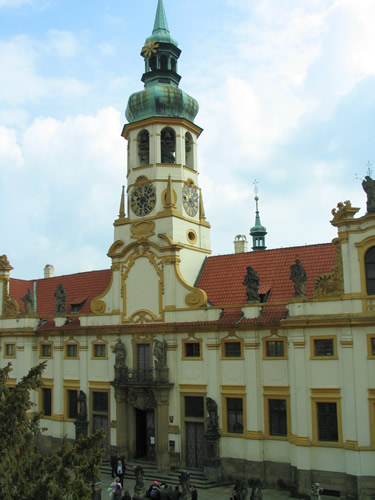
Since I wasn’t able to see the crown jewels but was in the general vicinity, I did pay a visit to the Loreto, which houses a replica of the Santa Casa in Loreto, Italy. (I highly recommend the website’s virtual tour.)
Loreto, Prague
Reportedly, the Loreto was built during the 17th century as part of the Catholic campaign to attract the Czechs back to Catholicism.

Besides the Church of the Nativity and the Santa Casa, the complex houses a treasury which was well worth the visit. The most stunning piece on display was a diamond-encrusted monstrance known as the Prague Sun.

The entrance fee of 110 CZK is waived for priests and religious, which I thought a charming professional gesture.

I’m told by one of my students that replicas of the crown jewels are on permanent display at Karlštejn (a castle near Prague), so I suppose I’ll have to make the trek out there one of these days. It won’t be quite the same, but at least I’ll get a rough sense of what I missed.

Sunday
April
20th
2008
1:13 pm

The Phantom of the Opera: A Ballet

I visited Národní Divadlo (the National Theater) to go to the opera, so now it was time to visit Státní Opera (the State Opera) to go the ballet. (To make this come full circle, I’d need to attend a play at the National Ballet, but, alas, there is no such theater. The National Ballet also performs at Národní Divadlo).

I went to see Phantom of the Opera, which recently premiered and which is billed as a "dancing horror love story". It follows the basic story line so familiar from Gaston Leroux’s original story and all the many dramatizations that have followed, except that, suitably enough, Christina is now a dancer, and the Phantom has composed a ballet to showcase her talents. (But so why, then, did they not call it Phantom of the Ballet?) The guiding force behind this production was Libor Vaculík.

I was reasonably pleased by the ballet. The music didn’t particularly impress me (and a few passages put me strongly in mind of Sir Andrew Lloyd Webber!), and while the dancing was of a fine calibre, the choreography emphasized more telling the story than dancing. I would very much more like to see how the company can dance than how it can act. They did manage to introduce a welcome note of humor into the drama, and I have no complaint with the dancers.

The theater itself is an exquisite little jewel box, and I look forward to returning. With both Státní Opera and Národní Divadlo, my mental standard for comparison is the San Francisco Opera House, which is downright cavernous by comparison. These theaters are much more intimate, and I don’t think that there can be a bad seat in the house.

The day was really quite nice: it’s a pity that I couldn’t have gone to the ballet yesterday and had today for my trip to Kŕivoklát!

Saturday
April
19th
2008
2:13 pm

Another Weekend, Another Castle

Once again, I turned to my handy little guidebook for ideas on where to go outside of Prague, and this time I settled on Křivoklát. Its appeal is that it was described as a sort of "living museum of medieval life and crafts". Reportedly, there are resident artists and craftsmen whose products are for sale.

To get there, I took the train to Beroun, then transferred to the train for Křivoklát. The train to Beroun is the one also taken by visitors to Karlštejn, so the train nearly completely emptied out there.

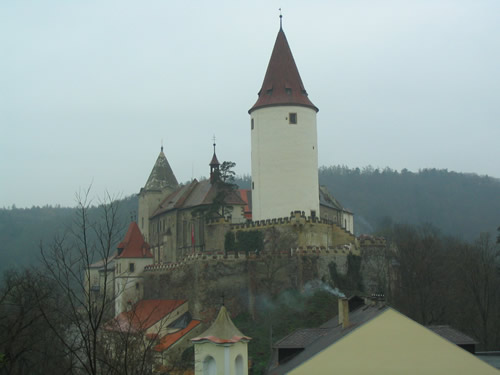
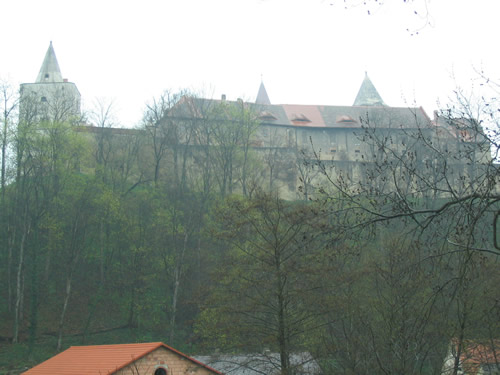
Křivoklát started as a hunting lodge before being converted into a more defensible structure, so it’s considerably less ornate than many other Czech castles. As seen from the train station:
Krivoklat
And the view from an adjoining hillside:
Krivoklat

Perhaps because it was a weekend, I don’t know that I saw any of the reputed resident artists or craftsmen. Their works, though, were indeed available for sale, and while there wasn’t a whole lot, what there was was varied and much more interesting than the usual tourist fare. There was wood work and metal work, fabrics, paintings, products made with honey and with bees’ wax.

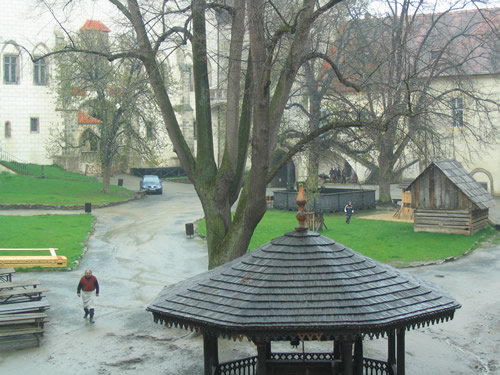
There weren’t many people about at all; that it was pouring rain probably had something to do with that! The inner courtyard:
Krivoklat courtyard
There was one couple who were getting married at the castle, although from what little I could see of the room reserved for that purpose, it hardly seemed a romantic setting. And after the wedding, the wedding party turned out in the courtyard for pictures, with umbrellas overhead and the poor bride trying to keep the hem of her white gown out of the mud.

At this time of year, there was no English-language tour of the interior available; instead, I was given a folder with the text of the tour and sent off to join the Czech tour. The covers were color-coded, so I could tell that there were two other English-speaking couples and one German couple. The interior was not particularly noteworthy, although there was a very nice chapel. There is also a dungeon with an impressive display of torture equipment.

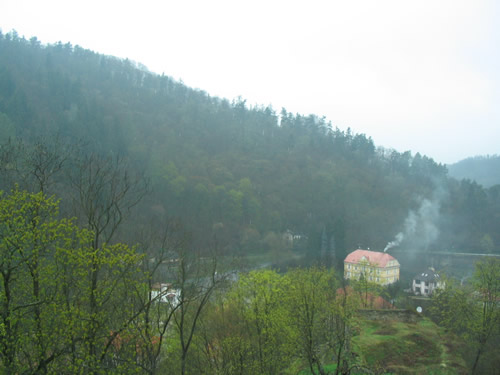
The countryside is lovely, and it would be worth coming back just to wander in the hills:
Krivoklat
I had time to kill before the train came, so I hiked around a little, but the persistent rain (oh, and I was umbrella-less) discouraged me from going too far.

You are currently browsing the archives for the Life in the Czech Republic category.

Looking for more?

Add to Technorati Favorites


follow webgeekstress at http://twitter.com
Random books from my "Currently Reading" stack...