May 8 is a holiday in the Czech Republic (as it is in France and elsewhere) celebrating the Day of Liberation (the end of the 2nd World War). Since it fell on a Thursday, I persuaded (without great difficulty) my Friday classes to forego their lessons on the 9th, and visited Olomouc for a long weekend.
Why Olomouc?
Much as I like Prague, I’d really like to try living elsewhere in the Czech Republic. When I started asking around for alternate places to live, Olomouc was one of the names that cropped up most often. The second largest city in the Czech Republic, Brno, was usually dismissed as an unattractive industrial city that I would find boring. Olomouc, on the other hand, is a university town (of its population of 100,000, an estimated 20,000 are students). Olomouc’s main claim to fame these days is the Holy Trinity Column, which is a UNESCO World Heritage Site.

Historically, Olomouc was the capital of Moravia (although Brno now claims that distinction). It is also where Václav III, the last of the Přemyslid kings, was assasinated on his way to Poland to claim the Polish crown.
Sightseeing
Besides the Holy Trinity Column, Olomouc’s other main claim to fame is the Astrological Clock at City Hall:

The clock itself is centuries old, although the mosaics surrounding it date from the Communist era. Olomouc has suffered the mosaics to remain because, despite the political implications, it really is quite stunning art work.
Olomouc is also noted for its fountains. There’s the Cæsar fountain:
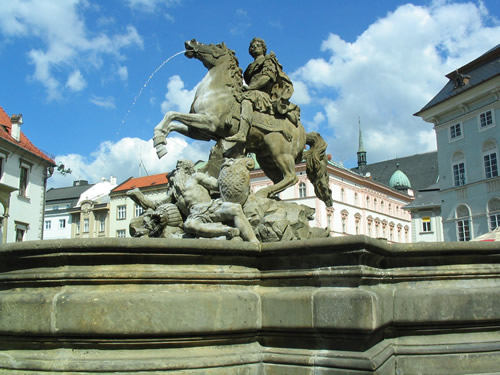
It’s not as unlikely as it seems: the ancient tradition is that Olomouc was founded by Julius Caesar and indeed the name of the city is a corruption of "Julius’s Mont". And archaeological findings under what is now sv. Michael’s church in fact confirm a Roman presence.
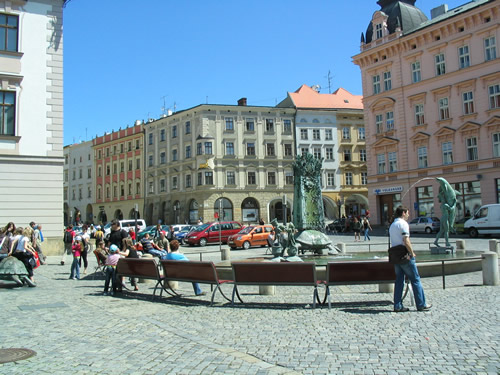
The relatively recent Arion fountain is a great favorite, especially because of the turtle sculpture that adjoins it:
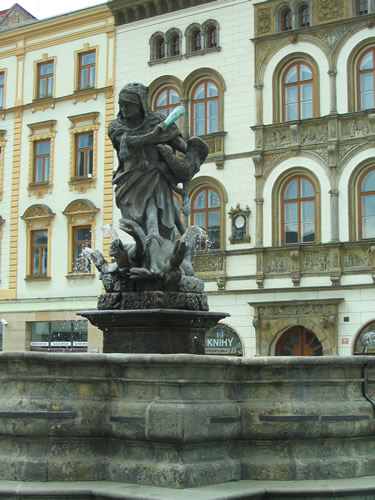
The Hercules fountain shares plaza space with the Holy Trinity Column:
Besides the Holy Trinity Column, there’s a Marian plague column, erected by plague survivors to celebrate their survival:

There’s a little bit of the former Yugoslavia just outside the old city walls:

It was built to provide a resting space for Yugoslav soldiers killed during World War I, and, much like an embassy, the government gave the land to the government of Yugoslavia. The remains of the soldiers were subsequently repatriated sometime when Tito was on the outs with the Czechoslovak government, and the crypt fell into disrepair. The Olomouc city officials have recently persuaded one of the new countries that was formed by the dissolution of Yugoslavia to take responsibility for the (now empty) crypt, so with luck it will be spruced up soon.
The Church
The cathedral in Olomouc is sv. Václav:

The chapter house of the cathedral is where Václav III was assassinated:

I was in Olomouc over Pentecost, so I attended Mass at the cathedral on Sunday. Fittingly enough, they were celebrating Confirmation that weekend: about two dozen adults were confirmed. I noticed that those attending Mass were rather more formally dressed than I’ve been accustomed to in churches here, but maybe that was just because it was the cathedral or because of the Confirmations. The area immediately adjacent to the main altar is mostly kept locked if there isn’t a service, so there’s a chapel off the outer nave where the Sacrament is reserved. I also noticed that people stopped to genuflect in front of that chapel as they were entering and leaving the main altar area.
The Archdiocesan Museum adjoins the cathedral:
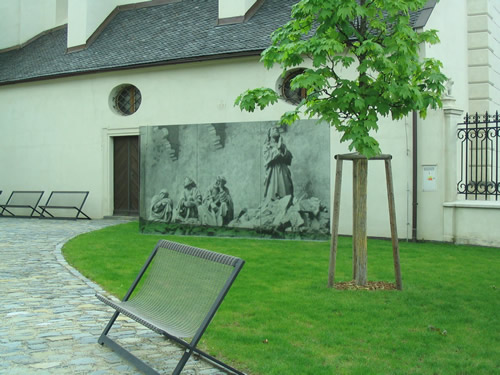
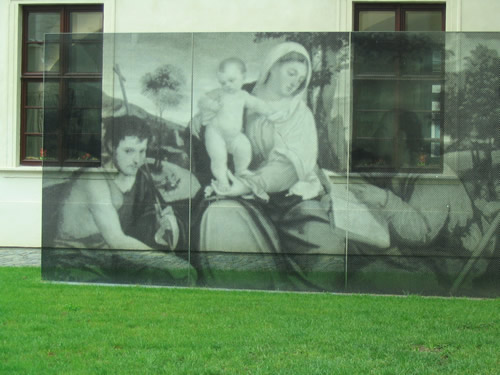
It’s a little surprising to me that, after 40 years of Communist suppression, the Church still has any treasures left. And actually, it does sometimes seem to me that the "jewels" in monstrances and the like are only cut glass (although that could be a security measure).
I also visited the Basilica of the Visitation on Holy Hill, a major (well, major for the Czech Republic) pilgrimage destination:

While the main entrance has been repainted, they haven’t (yet anyway) attended to the back or sides:

It put me in mind of an old Peanuts cartoon: Linus is showing off his newly shined shoes to Lucy, and as he turns to go, Lucy points out that he has only shined the fronts of his shoes, and not the backs. Linus replies that he cares what people think about him only when he’s arriving, not when he’s going.
St. John Sarkander
The closest thing that Olomouc has to a home grown saint is John Sarkander, who is venerated as a "martyr of the confessional". He was accused of treason by Protestant leaders and tortured partially due to his refusal to divulge what was said in confession. He died as a result of the torture, and the prison where he was held has since been converted into a chapel in his honor:

There’s also an altar with his relics in the cathedral. Although he died in 1620 and a cause for his canonization was started soon afterwards, he wasn’t beatified until 1860, and he was canonized only in 1995 by Pope John Paul II.
Dance
The Moravian Theater is the home for ballet and opera as well as drama. While I was there, the ballet was performing The Beatles and Queen, which sounded like an intriguing combination, especially for a ballet.
The music was presented (more or less) chronologically and the dance mimed the history of each group. It was very lively and went over well with the audience.
Haná Cuisine
I don’t really know enough about Czech cuisine to speak authoritatively on the differences between Bohemian and Moravian cooking, but I did notice a few little differences. Garlic soup, for example, is much heartier in Moravia; it includes ham and poached egg. And I was surprised by the "Chicken à la Duck": yes, the menu said it would be accompanied by sweet and sour cabbage, but I was expecting red cabbage, whereas this was white cabbage. And generally, white cabbage was more popular here than the red, whereas in Prague, it always seems to be red cabbage.
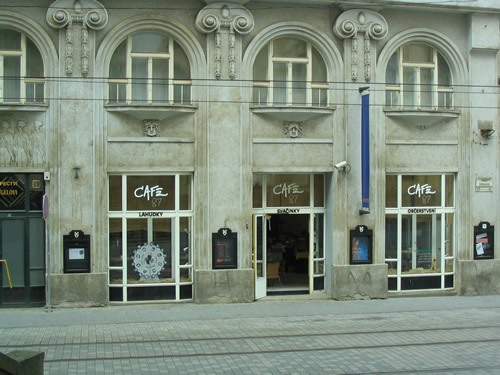
Olomouc’s Cafe 87 also has the only chocolate dessert that I’ve found worth eating in the Czech Republic: a bittersweet chocolate pie. The other chocolate desserts I’ve encountered in the Czech Republic have seemingly been based on milk chocolate and poor quality milk chocolate at that. Most baked goods also seem stale, or maybe Czechs just like their pastries on the dry side, but they’re not to my taste.
I also tried (I think!) the famed Olomouc stinky cheese, but I was seriously disappointed. The aroma was very mild and not particularly unpleasant; the flavor was unremarkable; and the texture was very waxy. In fact, after the first bite, I took another look to make sure that I hadn’t overlooked a rind or wax covering that I was supposed to remove first! I tried asking the waitress if there had been a mistake, but unfortunately, neither her English nor my Czech was up to the task. So I don’t know if I was (inadvertently perhaps) cheated or if Olomouc stinky cheese really does not live up to its reputation.
The Joys of Czech Trains
I was seriously unprepared for the business of traveling by train over a holiday weekend. There are several trains a day between Prague and Olomouc, so I didn’t figure that, even for a holiday weekend, I would need to book in advance, and buying a ticket on Thursday was no problem. When I got on the train, though, not only was every seat taken, but the aisles and vestibules were also crowded. I was "lucky" enough to be able to claim a stairwell in the vestibule, but mostly I stood for the three-hour trip to Olomouc.
I wasn’t in a mood to repeat that for the return trip, so I made a seat reservation. The return train, though, had originated in Kraków and passed through Ostrava before getting to Olomouc so it was already standing room only. There was such a crush of people boarding I couldn’t stop to look for my seat until we were already underway, at which point, I found that I was at the opposite end of the car (fortunately I was at least in the right car!). Looking at the mass of people and luggage crowding the aisle, I was going to give up. However, the two very nice Czech ladies who were trying to get me oriented weren’t having any of that and handed me over to the conductor. The conductor went off with my ticket, leaving me no choice but to follow, stepping over my fellow passengers with many an apology.
When we located my seat it was, of course, occupied, and by a woman with a child sleeping in her lap. Fortunately, the man in the seat opposite chivalrously gave up his seat (and stood for 90 minutes to Pardubice) so that I wasn’t in the awkward position of having to oust a mother and child from my place.
Moral of the story: next time I travel on a summer weekend, I’m not only booking my seat in advance, I’m also going first class!
What Else?
I took way more pictures, but they don’t really fit into the narrative, so there’s a supplemental slideshow.
And it really is true that once you get outside of Prague, people don’t speak as much English. German is popular, which makes sense since the Czech Republic is bordered half-way around by German-speaking countries, and in Olomouc, Polish is reasonably popular, which again makes sense. But not a lot of English.