
For my birthday, I decided to treat myself to a weekend out of town. I had originally thought of Karlovy Vary, but was told that "Ah, there’s nothing but rich Russians there!". Mariánské Lázně (which may be better known to some as "Marienbad"), on the other hand, was described as still being more Czech. Well, I’m in no position to compare, but there was certainly no shortage of rich Russians at Mariánské Lázně!
I stayed at the Nové Lázně, which is arguably the grandest of the spa hotels:

I had a very comfortable room overlooking the park:


That’s the Church of the Assumption in the upper right; here’s a closer view of this octagonal church:

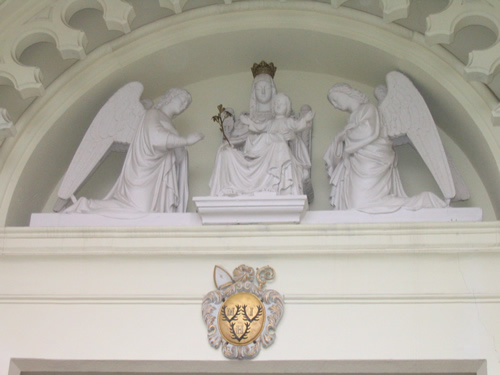
And the archway over the door:
The assurances of the travel agency through which I arranged my stay notwithstanding, English was in short supply: there was German and Russian in abundance, but very little English. I spent most of my weekend communicating with the staff in mime, my highly limited Czech, and guessing at German!
When I showed up at the dining room for dinner, there was a brief flurry as the hostess, who spoke very little English, summoned a waiter to figure out where to seat me. The hostess and the waiter had a brief discussion, in which the only Czech word that I recognized was "Angličanka" (Englishwoman), after which I was led to a table which I shared with a very nice woman from Britain. She was coming up on the end of a two-week stay at Mariánské Lázně, and professed herself to be delighted to be able to have someone with whom she could speak English.
They take the whole "health resort" thing very seriously, and indeed, they don’t seem all that keen on catering to weekend dilettantes. I had to have an interview with a nurse before I could schedule any treatments, and supplemental services were either fully booked already or were simply unavailable over a weekend. Fortunately, my package included two treatments a day, and those were provided: I had two each of the partial medical massage, dry CO2 bath and mineral bath.
The dry CO2 bath was the most unusual experience. Here is the brochure description:
This is another signature treatment of the spa resort of Marienbad where the gas – Marie’s gas – that bubbles naturally out of the ground is used for the treatment. This gas is of volcanic origin and contains 99.7% CO2. In our other resorts normal commercial CO2 gas (the same as in the food industry) is used. During the treatment you lie fully clothed, comfortably on a bed enclosed in a large plastic bag that is sealed just under the arms. The gas is then pumped into the bag, which slowly inflates, where it is absorbed through the clothes and skin into the body where it slows down heart activity and reduces blood pressure. The gas also improves blood circulation and kidney activity and has an anti-inflammatory effect. The gas is also known to stimulate the production of the sexual hormones, testosterone and estradiol, which is why it is successful for the improvement of sexual functions and to relieve menopausal symptoms in women. Time: 30 minutes, Doctor’s prescription required: No, Benefits: Therapeutic, Well Being.
The mineral bath is pretty well self-explanatory, but here’s the brochure description for that one:
This is a signature treatment, exclusively provided in the spa resort of Marienbad using the natural local mineral waters and natural CO2 gas that naturally seeps out from the ground. The water is heated to a temperature of between 28-34° C in an individual bathtub, into which is pumped the natural CO2 gas that fizzes onto the skin, producing a relaxing, tickling sensation. The carbon dioxide is absorbed through the skin into the body, where slows down the heart activity and reduces the blood pressure. Several treatments will result in improved blood circulation, heart and kidney activity as well as reduced stress and anxiety. The benefits and procedures are similar to the carbon dioxide bath treatment, however the advantage here is that all the properties used are both local and natural. Time: 20 minutes + dry wrap (15 minutes), Doctors prescription required: no, Benefits: Therapeutic, Well Being
The thing that surprised me most about the mineral bath was that the water was no more than tepid! One of the ubiquitous rich Russians I chatted with one evening told me that, to get a hot mineral bath, I should go to a Hungarian spa!
In keeping with the whole "health resort" routine, life in Mariánské Lázně is very tranquil, and there’s not a lot to do. The main tourist attraction (aside from the waters and spa treatments) is the Singing Fountain:


Every other hour during the season, the fountain "performs" to a soundtrack of such pieces as Petr Hapka’s Music for the Fountain or Chorus of Hebrew Slaves from Verdi’s Nabucco or Dvořák’s Carnival, Op. 92. As my dinner companion pointed out, it would be more accurate to describe it as the "Dancing Fountain", rather than the "Singing Fountain". According to some of the flyers and brochures I saw around town, it looks as though the singing season is supposed to end on October 30. I guess they knew I was coming, though, because the Gala Closing actually took place on my birthday!
The fountain is in the Colonnade park:

The park also has a statue of Abbot Reitenberger of Tepla Monastery:

The abbot is credited with having established the spa town.
And perhaps it’s to cater to those rich Russians that this Church of St. Vladimir was built:

