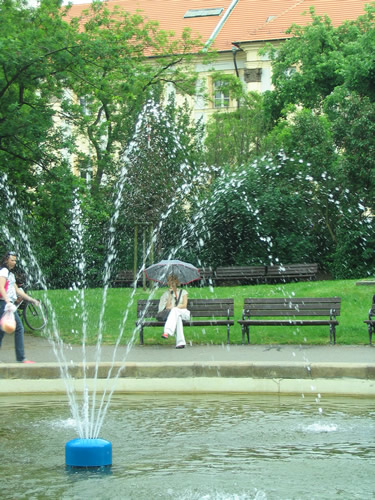
I taught my last two English classes of the academic year this morning. Whew!
Now to take the teacher hat off and put my student hat back on: that’s right, Czech classes for me this summer! What fun.
 Yurtdışında Yaşam
I'm finally satisfying a long-held dream of living abroad. I started with six months in France followed by two and half years in the Czech Republic. Now, I'm giving Turkey a try.
I taught my last two English classes of the academic year this morning. Whew!
Now to take the teacher hat off and put my student hat back on: that’s right, Czech classes for me this summer! What fun.
Well, I’ve set up an account on Twitter: twitter.com/webgeekstress. I’ve resisted this for a while: after all, I already have my blog! But, hey, all the other cool kids are twittering, and I was feeling left out.
Unfortunately, the name puts me in mind of a former and massively unlamented manager. My description of her ignorance, lack of humor, and propensity for parroting the latest management idea du jour prompted my mother to dub her "Twitty". The name was so thoroughly apropos that not only did I adopt it, but several of my co-workers did as well.
I suppose I should feel guilty… it does seem rather childish now. I don’t, though; in fact, I had a subsequent manager whom I think of as "Twitty Two".
For the Feast of the Body and Blood of Christ (formerly known as Corpus Christi), sv. Tomáš again had one of these joint Czech / Spanish / English liturgies. The reason for the joint liturgy was to ensure that we would have enough time for a procession after Mass:

We processed from sv. Tomáš to sv. Josef, which we entered and had a brief prayer and hymn in Spanish. From sv. Josef we went on to the Order of Malta church of Panna Marie Pod Retězem (Our Lady Beneath the Chain), where we switched to English for our prayer and hymn.
Aside: I’ve never heard of a devotion to "Our Lady Beneath the Chain". On Googling, the closest I could find was a devotion to Our Lady of the Chain, which originated at the end of the 14th century in Sicily, but apparently made it Malta early on. So I think this is just a confusion of prepositions.
The story in brief is of three young men condemned to die on the gallows. While awaiting their execution, in the church of St. Mary of the Port, they were chained, kept under guard, and the doors of the church were securely locked. That night, the guards that were on duty fell asleep and the three condemned men found themselves at the foot of an image of the Blessed Virgin Mary. They prayed fervently for deliverance. While they were praying, the chains mysteriously fell to the ground. The doors of the church opened by themselves, and they heard these words coming from the image of the Blessed Virgin: "Go, you are free, do not fear. The Divine Infant Whom I hold in my arms has heard your prayers and has granted your freedom." The prisoners silently walked out of the Church.
When the guards awakened, they went after and, finally, caught up with their prisoners. The men would have been chained again and taken away for execution, had it not been for the people who interceded for them with the King. The King, having heard what had happened, granted them their freedom, saying: "The Blessed Virgin Mary has set them free, so will I."
The final stop on our procession was the Infant of Prague church of Panny Marie Vítězné (Our Lady Victorious), where we finished up in Czech.
As on previous occasions when we’ve had processions, we gave the tourists a thrill.
So, casting about Saturday for something to do, I ran across a reference to a Japanese Spring Festival at Vyšehrad.
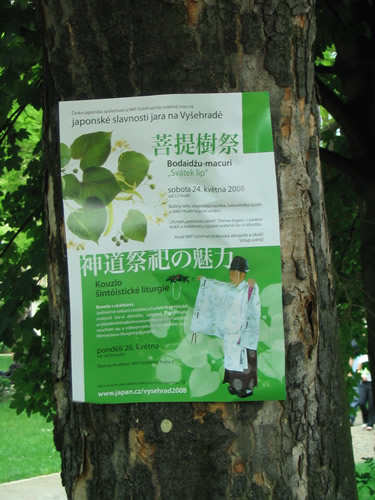
Curious, I headed out to Vyšehrad.
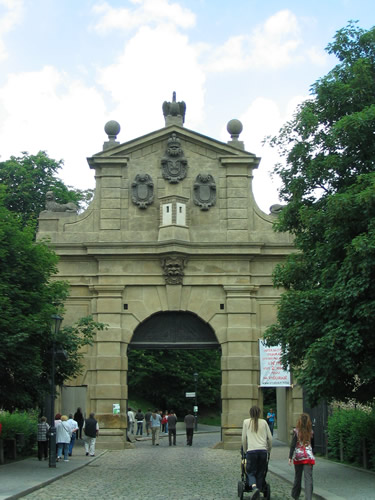
While searching for the clearing where the Festival was to take place, I ran across a playground:
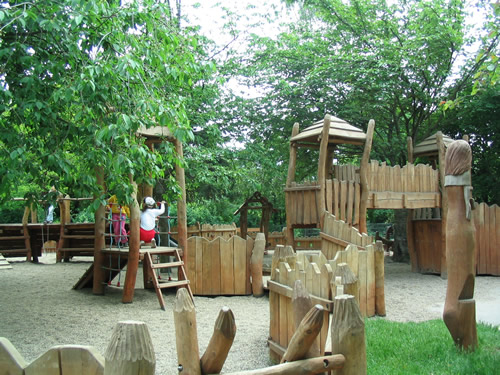
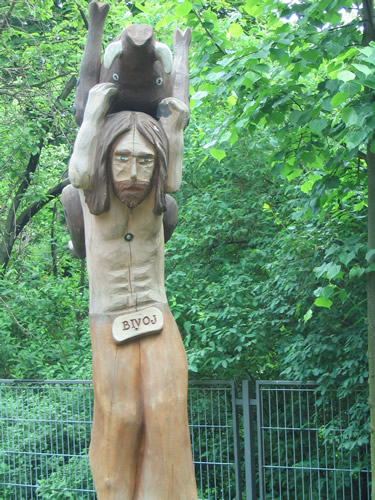
There were some wooden sculptures scattered about, but I have no idea who (or what) they represent:
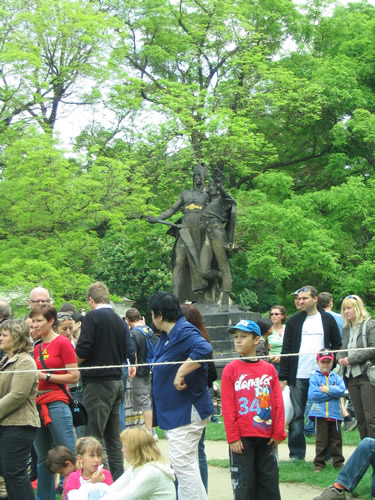
When I found the clearing, people were just milling around:
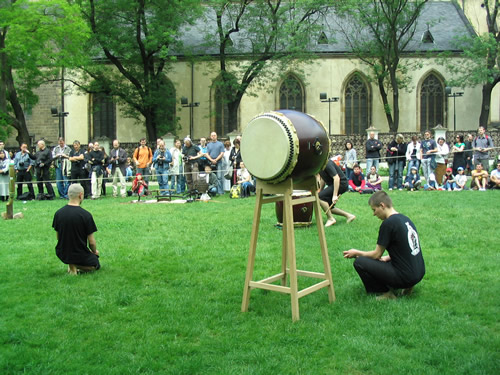
But soon, they set up the drums:
Next, the banner came out:
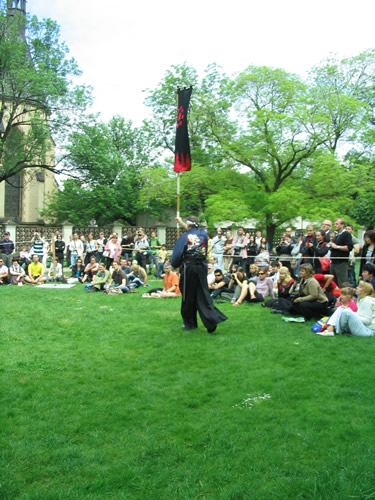
I have no idea what this was, but it was brought onto the field next:
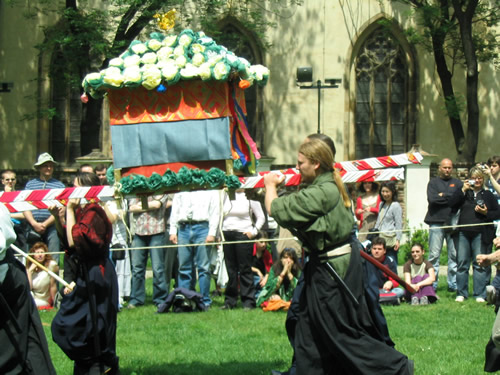
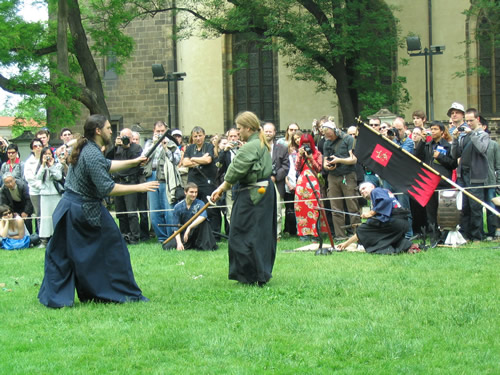
Finally, the games began. We had some mock swordplay:
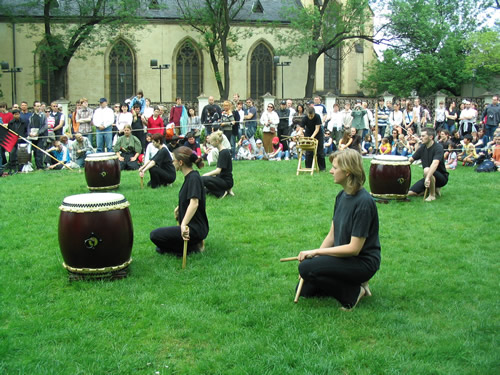
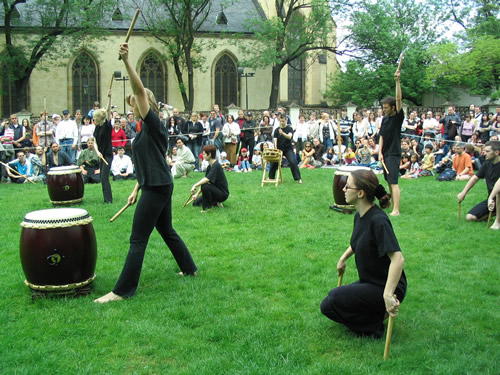
There was drumming:
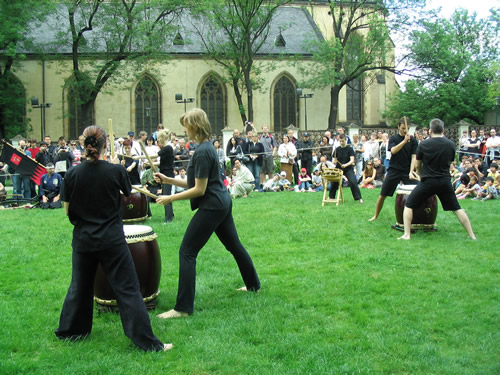

Next, we had the archers:
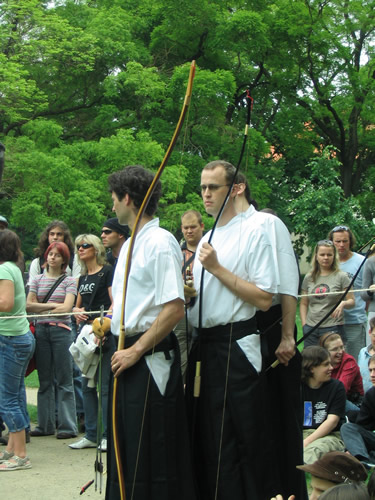
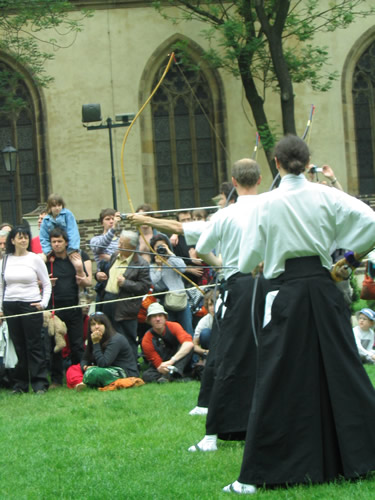
The participants in these displays all appeared to be Czech; they did not at any rate appear to be Japanese. There was a platform set up at one end of the clearing, and after the first round of games, some Japanese men took their places on the platform:
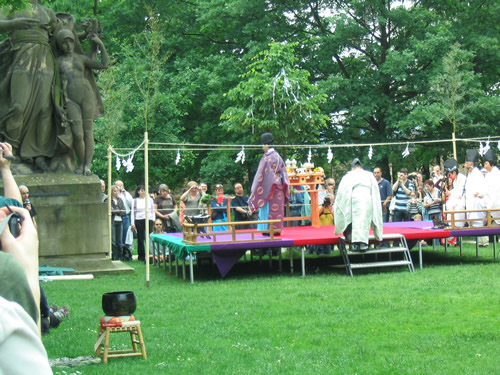
The main participants were recognized:
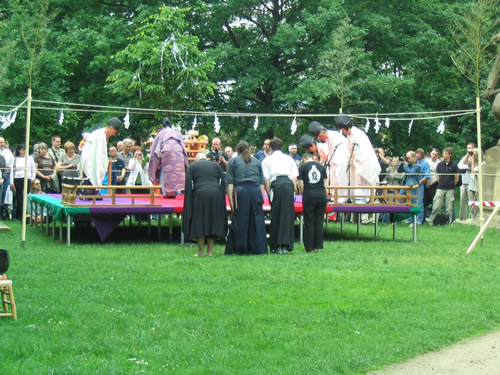
And then, it looked as though it was all starting over again, beginning (or resuming) with the mock swordplay. So, I pretty much lost interest, and wandered off.
The clearing where the festival was taking place was right next to the Basilica of Sts. Peter and Paul:
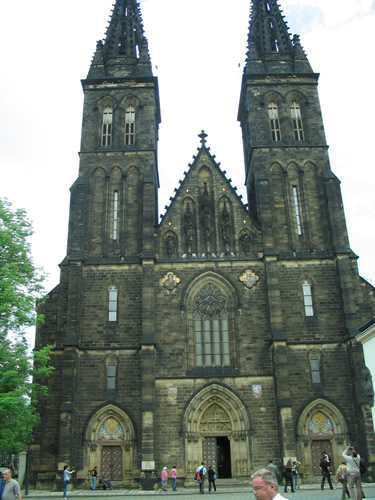
Closeups of the icons of Sts. Paul and Peter (respectively) that appear to either side of the rose window:

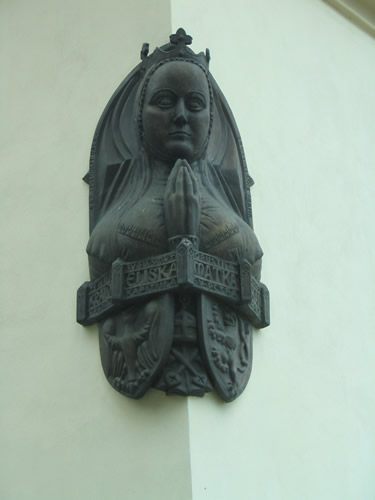
A nearby building has Elizabeth of Bohemia (the sister of Václav III, who was assassinated at Olomouc, ending the male Přemyslid line, and the mother of Charles IV) looking out from a corner, though why precisely, I couldn’t say:
I wandered back to the clearing, and found that we were back to archery, so I continued my meandering and visited the cemetery adjoining the basilica. The grave of Milada Horáková was attracting the most visitors:
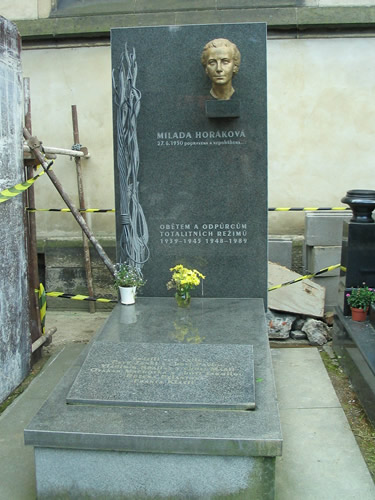
Mrs. Horáková had been a member of the Czech Resistance during WWII and spent time in Nazi prisons for her pains. She was subsequently an outspoken opponent of the Communist government, which executed her for treason in 1950. As a result, she is now considered a modern Czech heroine.
Even in death, (some) Czechs can be very particular about their titles, and you so you get "Dr", "MUDr", "JUDr" and "Ing" on the tombstones:

This tombstone simply pleased me: it’s highly distinctive:
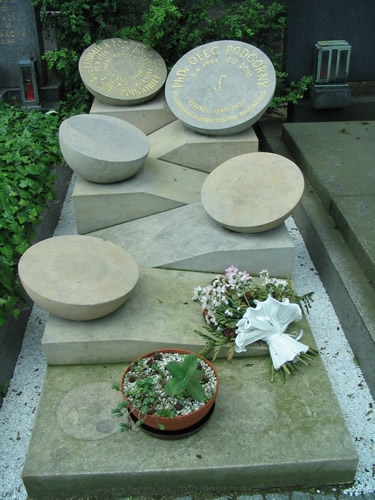
I believe that this part of the cemetery is reserved for the convent:
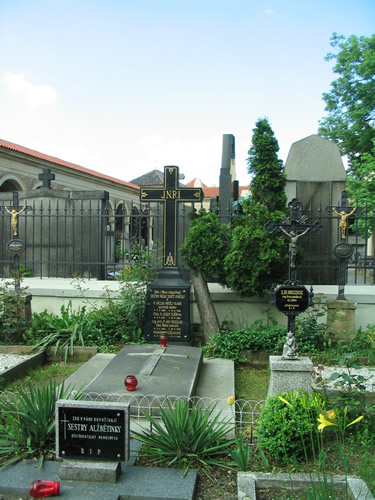
And, looking over the cemetery to the basilica:
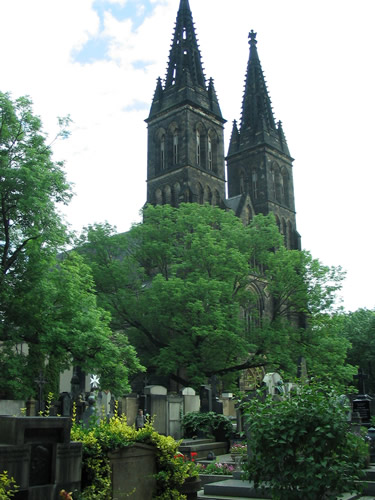
Returning to the clearing, we were on drumming again. So I gradually wandered my way out of Vyšehrad. I didn’t know what this was when I photographed it, but it appears that nowadays at least it’s being used as a gardening shed:
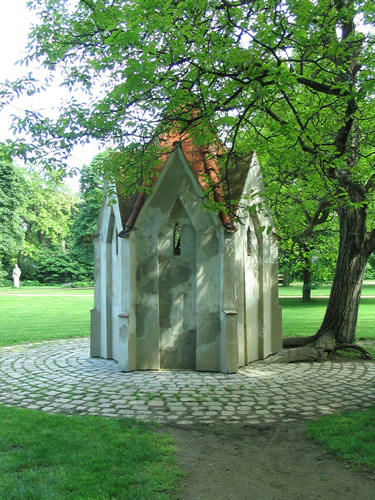
I’m sure that it must have been built for something else, but who knows what?
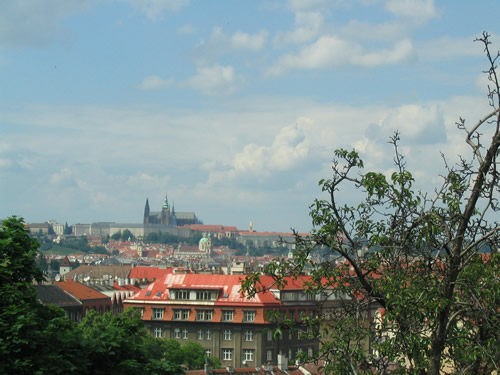
And just a final shot, looking across to Prague Castle from Vyšehrad:
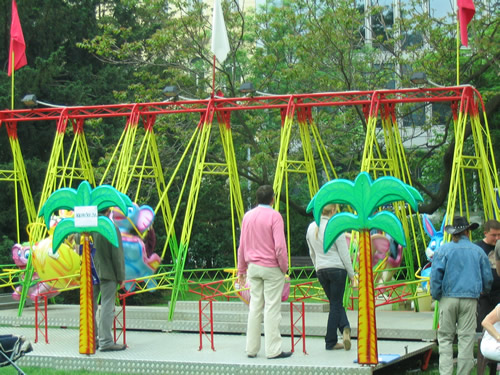
I don’t know if it was related to the feast of John of Nepomuk on Friday, but on Saturday, sv. Ignace was holding a fair at Karlovo Náměstí. There was a swing set for the kiddies:
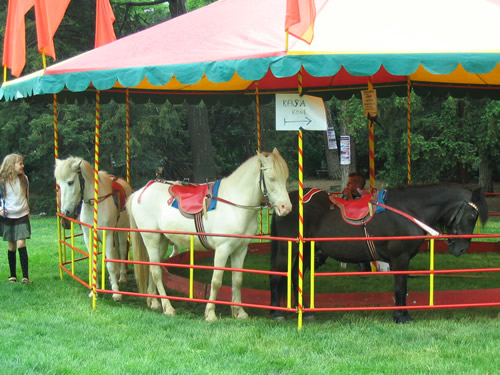
And a pony ride (I wanna ride a pony!):
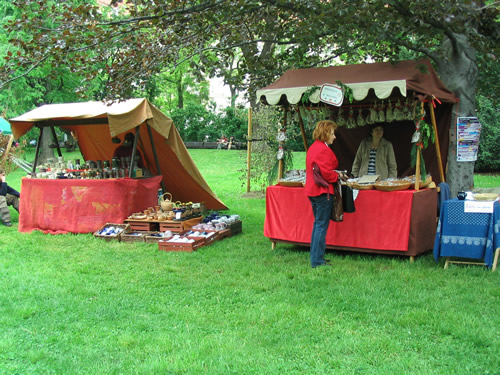
There were craft booths:
And this being Prague, of course there was beer. And not just any beer, but Pilsner Urquell:
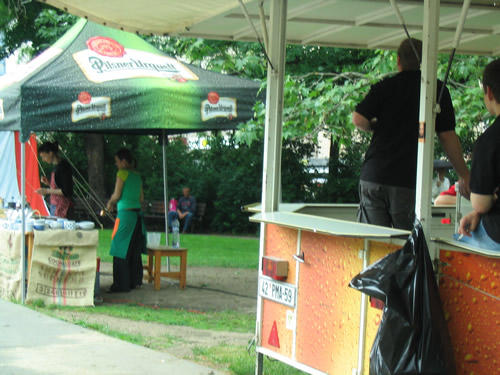
Of course, some people were content to just sit back and watch: